Two Countries Supply Most of the World's Uranium
While OPEC's influence over oil dominates headlines, a far tighter duopoly controls the fuel powering the global nuclear renaissance.
As the global transition toward clean energy accelerates, nuclear power is staging a significant comeback. Across Europe, Asia, and the United States, governments and utilities are looking to nuclear energy to provide reliable, carbon-free baseload power. However, this nuclear renaissance is highly dependent on a remarkably concentrated supply chain. While the global community frequently focuses on the geopolitical leverage of oil-producing nations, a much tighter resource chokepoint exists in the nuclear sector. Just two countries—Kazakhstan and Canada—dominate the global supply of uranium, creating a critical dependency for the future of clean energy.
The Scale of the Uranium Duopoly
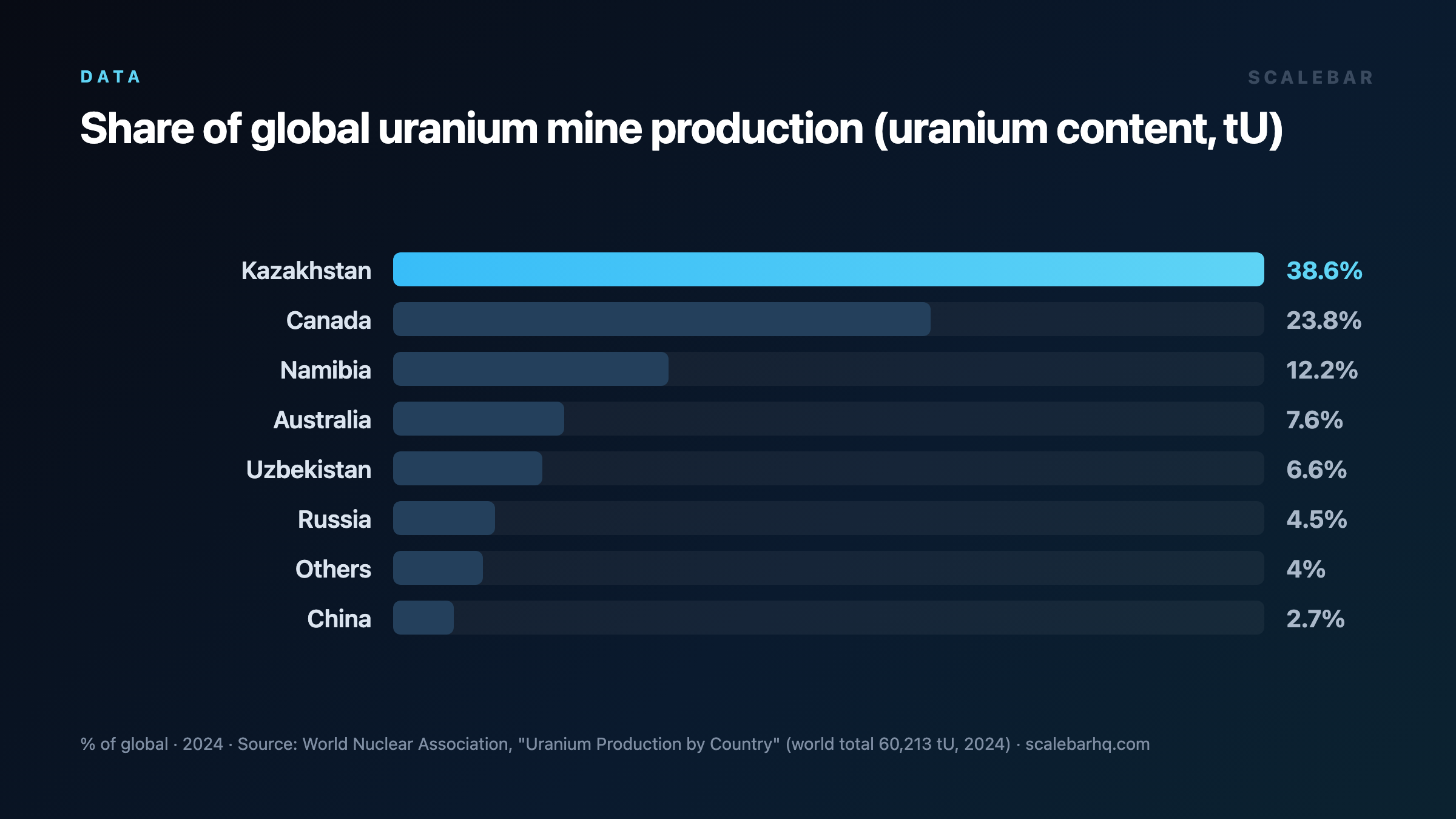
In 2024, global mining operations produced approximately 60,300 tonnes of uranium. This fuel is essential for keeping the world's nuclear reactors running, yet its extraction is concentrated in very few geographic regions.
Kazakhstan stands as the undisputed giant of the industry, producing 39% of the world's uranium in 2024. Canada follows as the second-largest producer, accounting for roughly 24% of the global supply. Together, these two nations control 63% of global uranium production.
To put this concentration into perspective, it is helpful to compare it to the global oil market. The Organization of the Petroleum Exporting Countries (OPEC) controls roughly 36% of global oil production. The international community treats OPEC's market share as a massive geopolitical lever capable of shifting global economics. Yet, the combined market share of Kazakhstan and Canada in the uranium sector is nearly double that of OPEC's share in the oil market. Despite this immense concentration of a critical energy resource, the uranium duopoly rarely commands the same level of public attention or headlines.
Kazakhstan's Mining Advantage
Kazakhstan’s rise to the top of the uranium market is driven not only by the abundance of its natural resources but also by the specific extraction methods utilized within the country. Kazakhstan extracts almost all of its uranium using a process known as in situ leach mining.
Unlike conventional mining, which requires digging massive open pits or constructing deep underground shafts to haul out solid ore, in situ leach mining leaves the physical rock in the ground. Instead, mining operators pump a liquid solution directly into the underground uranium-bearing sandstone. This solution dissolves the uranium in place. The uranium-rich liquid is then pumped back to the surface, where the nuclear fuel can be processed and concentrated.
This extraction method offers significant economic and operational advantages. It is both cheaper and faster than conventional mining techniques, allowing Kazakhstan to scale its production rapidly and maintain a highly competitive cost structure. By utilizing in situ leach mining for almost all of its extraction, Kazakhstan has secured its position as the world's leading supplier, producing well over a third of the global total.
The Secondary Tier of Global Production
Behind the dominant shares of Kazakhstan and Canada, the drop-off in production is steep. The remaining global supply is highly fragmented, with only a few other nations contributing notable percentages to the global total.
Namibia and Australia occupy the next positions in the global hierarchy, but they remain far behind the top two. Australia produces between 8% and 10% of the global uranium supply. Namibia closely matches this output, producing approximately 9% to 10% of the world's uranium.
While Australia and Namibia remain vital players in diversifying the global supply chain, the enormous gap between these secondary producers and the leading duopoly underscores the vulnerability of the market. Beyond these four nations, very few countries possess the infrastructure or resources to contribute meaningfully to the global supply.
Implications for the Clean Energy Transition
As nuclear energy becomes increasingly central to global decarbonization strategies, the concentration of uranium mining presents both logistical and geopolitical challenges. Nuclear power plants require a highly secure, predictable, and consistent supply of fuel to operate. Because uranium cannot be easily substituted, any disruption in the primary producing nations could have cascading effects on global energy grids.
With Kazakhstan and Canada accounting for 63% of the 60,300 tonnes mined in 2024, the global nuclear sector relies heavily on the political stability, trade policies, and operational continuity of just two nations. As demand for nuclear fuel continues to climb, this two-country chokepoint is quietly becoming one of the most critical resource dependencies of the modern energy landscape.
Frequently asked
- Which countries produce the most uranium?
- Kazakhstan and Canada are the world's leading uranium producers. In 2024, Kazakhstan produced 39% of the global supply, while Canada produced roughly 24%. Together, they account for 63% of global uranium production.
- How much uranium was mined globally in 2024?
- In 2024, the world mined a total of approximately 60,300 tonnes of uranium.
- What is in situ leach mining, and who uses it?
- In situ leach mining is an extraction method where a liquid solution is pumped underground to dissolve uranium in place, which is then pumped back to the surface for processing. It is cheaper and faster than conventional mining. Kazakhstan uses this method for almost all of its uranium extraction.
- How does the concentration of the uranium market compare to OPEC's control of oil?
- The uranium market is significantly more concentrated than the oil market. While OPEC controls roughly 36% of global oil production, just two countries—Kazakhstan and Canada—control 63% of global uranium production.
- Which countries are the next largest producers of uranium after Kazakhstan and Canada?
- The next largest producers are Australia and Namibia. Australia produces about 8% to 10% of the global uranium supply, while Namibia produces about 9% to 10%.
Sources
- http://large.stanford.edu/courses/2018/ph241/bashti1
- https://en.wikipedia.org/wiki/Uranium_mining_in_Australia
- https://theoregongroup.substack.com/p/namibias-strategic-ascent-in-the
- https://world-nuclear.org/information-library/facts-and-figures/uranium-production-by-country
- https://world-nuclear.org/information-library/nuclear-fuel-cycle/mining-of-uranium/in-situ-leach-mining-of-uranium
- https://www.cer-rec.gc.ca/en/data-analysis/energy-markets/market-snapshots/2026/market-snapshot-canadian-uranium-exports-help-fuel-nuclear-generation-around-the-world.html?=undefined&wbdisable=true
- https://www.globaldata.com/data-insights/mining/production-of-uranium-in-australia-1093047
- https://www.mining-technology.com/analyst-comment/global-uranium-output-to-grow-2024
- https://www.sciencedirect.com/science/article/abs/pii/S0959652613006367
- https://www.statista.com/statistics/292590/global-crude-oil-production-opec-share
- https://www.statista.com/statistics/652996/distribution-of-global-uranium-resources-by-country
- https://www.visualcapitalist.com/ranked-who-controls-the-worlds-uranium-supply