Two Countries Control 75% of Earth's Helium Supply
A quiet duopoly controls three-quarters of the world's helium supply, leaving high-tech industries highly vulnerable to supply shocks.
When most people think of helium, they picture colorful party balloons drifting toward the ceiling. Yet, behind this whimsical association lies one of the most quietly concentrated and geopolitically sensitive supply chains on Earth. Helium is the second lightest element in the universe, but on Earth, it is a finite, non-renewable resource with no viable substitute for its most critical high-tech applications. Over the last decade, helium prices have climbed by over 100%, reflecting a tightening global market that reached a valuation of approximately 4.1 billion dollars in 2024. This dramatic price increase is not driven by party supply shortages, but by the extreme concentration of its production.
The Exclusive Club of Helium Producers
The global helium market is exceptionally exclusive. Worldwide, only seven countries commercially produce helium. This limited roster of producers makes helium one of the most tightly controlled commodities in existence, far surpassing the concentration seen in major fossil fuels or agricultural products.
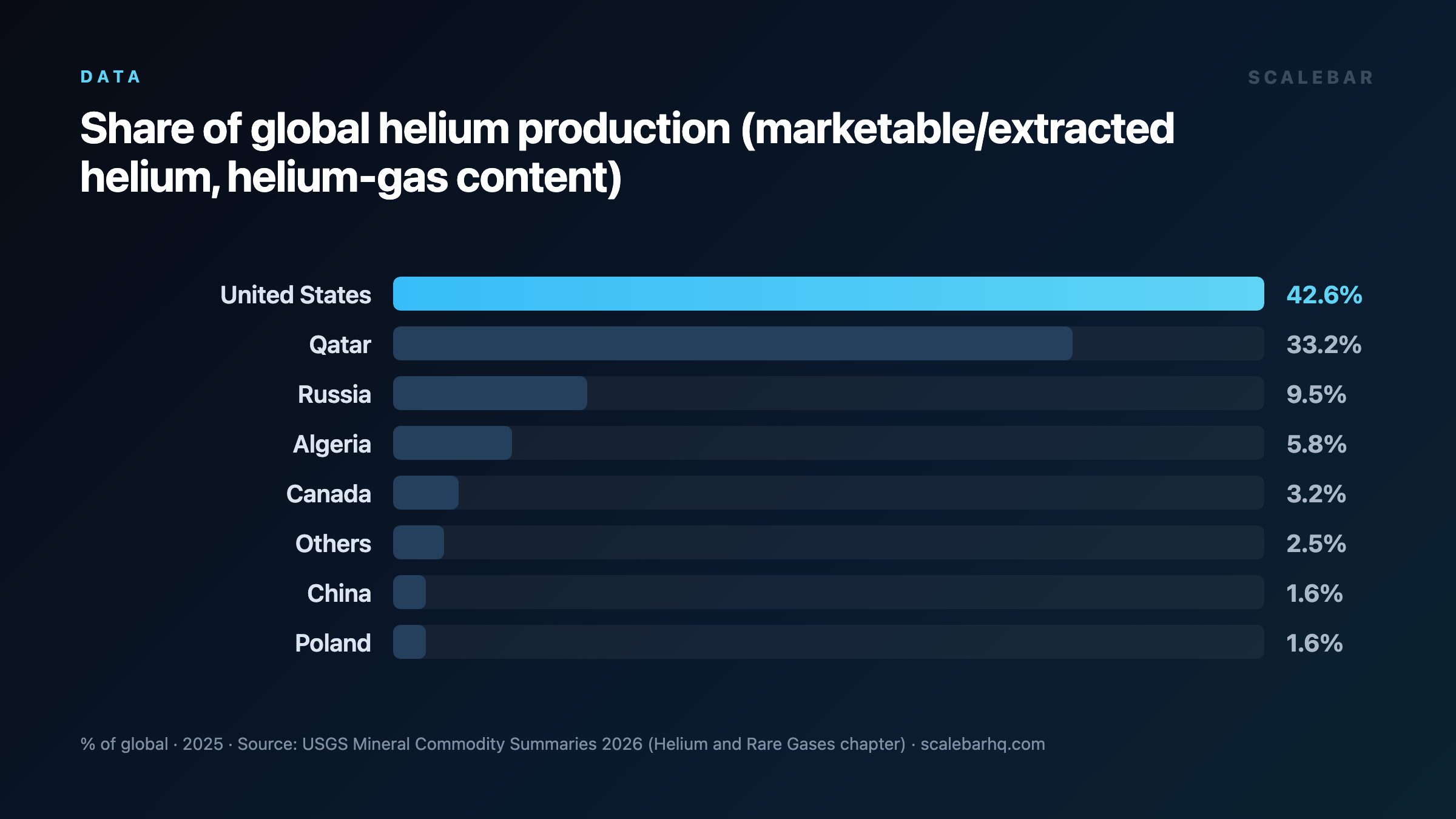
Within this small group of seven, the concentration of power is even more lopsided. Just two nations—the United States and Qatar—together supply approximately 75% of the world's helium. This duopoly leaves the rest of the global economy highly vulnerable to supply disruptions, geopolitical shifts, and policy changes in just two capitals.
Qatar's Natural Gas Engine
Qatar has emerged as a titan in the helium industry, covering about 34% of the global helium supply. Unlike many other natural resources that are mined directly, helium is typically extracted as a minor byproduct of natural gas processing.
In Qatar, this extraction is tied directly to its massive natural gas operations in the Persian Gulf. Because helium exists in very low concentrations within natural gas deposits, it can only be captured economically during large-scale liquefaction processes. Qatar's massive investments in liquefied natural gas (LNG) infrastructure have naturally positioned the country as a dominant force in the helium market. However, this also means that the global helium supply is intrinsically linked to the dynamics of the global natural gas market and the geopolitical stability of the Persian Gulf region.
The United States: A Shifting Giant
The United States has historically been the backbone of the global helium market, and it still holds a commanding position. The U.S. holds roughly 8.55 billion cubic meters in known helium reserves, representing a massive portion of the planet's remaining underground supply. However, the domestic landscape of U.S. helium supply has undergone a profound structural shift.
For decades, the U.S. relied on a massive federal buffer: the strategic helium reserve. In 1996, this strategic reserve held about 30 billion cubic feet of helium, acting as a crucial stabilizing force for global prices and supply. Over the subsequent decades, a policy of privatization systematically drew down this federal stockpile. By early 2024, the sale of the reserve was officially completed, leaving only a small fraction of the original supply remaining. With this buffer essentially gone, the market has lost its primary shock absorber. This transition from a state-backed strategic reserve to a fully privatized, market-driven model has contributed significantly to the price volatility and the over 100% price increase observed over the last ten years.
The Global Reserve Landscape
While the U.S. and Qatar dominate current production, other nations hold significant underground reserves that could shape the future of the market. According to data from the United States Geological Survey (USGS), Algeria holds approximately 1.8 billion cubic meters of helium reserves. Like Qatar, Algeria's helium potential is closely tied to its natural gas export infrastructure.
Meanwhile, Russia holds approximately 1.7 billion cubic meters of helium reserves. Russia has actively sought to develop its production capacity to challenge the U.S.-Qatar duopoly, but bringing these reserves to the global market involves navigating complex geopolitical tensions and infrastructure challenges. For now, these massive reserves in Algeria and Russia remain secondary to the active output of the market leaders, leaving the global supply chain heavily reliant on the U.S. and Qatar.
The High Stakes of Helium Scarcity
The extreme concentration of helium production is particularly alarming given the element's indispensable role in modern technology. Helium is not merely a luxury; it is a critical industrial input. It is vital for cooling the superconducting magnets in MRI machines, pressurizing fuel tanks in rocket engines, and manufacturing advanced semiconductors.
What makes helium uniquely vulnerable is its physical behavior. Because it is incredibly light and chemically inert, once helium is released into the atmosphere, it does not react with other elements or settle back to Earth. Instead, it rises to the edge of the atmosphere and eventually escapes Earth's gravity, floating into space forever. This makes helium a truly finite resource; once lost, it cannot be recovered or synthesized. As the global helium market hit about 4.1 billion dollars in 2024, the pressure on the remaining seven producing nations—and the dominant U.S.-Qatar duopoly—continues to mount, highlighting the fragile foundation of the global high-tech sector.
Frequently asked
- How many countries commercially produce helium?
- Only seven countries commercially produce helium worldwide, making it one of the most exclusive supply chains on Earth.
- Which countries dominate the global helium supply?
- The United States and Qatar dominate the global market, together supplying approximately 75% of the world's helium. Qatar alone covers about 34% of the global supply.
- Which countries hold the largest helium reserves?
- The United States holds the largest known reserves with roughly 8.55 billion cubic meters. Algeria holds approximately 1.8 billion cubic meters (according to USGS data), and Russia holds approximately 1.7 billion cubic meters.
- What happened to the United States' strategic helium reserve?
- In 1996, the U.S. strategic helium reserve held about 30 billion cubic feet of helium. However, the privatization and sale of the reserve was completed by early 2024, leaving only a small fraction of the original supply and removing a major market buffer.
- How much has the price of helium changed recently?
- Helium prices have increased by over 100% over the last decade, driven by supply concentration and rising demand in a global market that reached about 4.1 billion dollars in 2024.
Sources
- https://pubs.usgs.gov/periodicals/mcs2025/mcs2025-helium.pdf
- https://www.visualcapitalist.com/ranked-global-helium-production-by-country
- https://minerals.usgs.gov/minerals/pubs/commodity/helium/mcs-2025-helium.pdf
- https://pubs.usgs.gov/myb/vol1/2023/myb1-2023-helium.pdf
- https://www.blm.gov/sites/blm.gov/files/Pricing%20of%20Crude%20Helium%20-%20Final%20JRCI_101513%20Rev%201%20508_Redacted%20102016.pdf
- https://statranker.org/economy/resources-mining/top-helium-producing-countries-in-the-world-2025-ranking
- https://www.cnbc.com/2026/03/19/the-iran-war-is-threatening-supply-helium-what-it-means-for-markets.html
- https://pubs.usgs.gov/periodicals/mcs2024/mcs2024-helium.pdf
- https://www.sciencedirect.com/science/article/abs/pii/S0921344923000721
- https://www.linkedin.com/posts/andrewyhchan_7-countries-produced-all-of-the-worlds-commercially-activity-7445628642581200896-1o5F
- https://elements.visualcapitalist.com/charted-helium-production-by-country
- https://www.linkedin.com/posts/hichem-rezgui-974b7924_energy-helium-algeria-activity-7388927394562330624-QrOB
- https://www.statista.com/statistics/925805/helium-reserves-worldwide-by-country/
- https://www.technologyreview.com/2024/02/25/1088930/global-helium-market-semiconductors/
- https://www.factmr.com/report/helium-market
- https://www.nationalacademies.org/read/9860/chapter/3
- https://www.igascn.com/global/detail/?TypeId=1036&Id=7506&SortSource=relate:
- https://theoregongroup.substack.com/p/helium-crisis-puts-us-in-control
- https://www.grandviewresearch.com/industry-analysis/helium-market-report