2 Countries Grow Most of the World's Palm Oil
Indonesia and Malaysia control over 80% of the global palm oil supply, creating an unprecedented geopolitical concentration for a critical global commodity.
From supermarket biscuits to household shampoos, palm oil is an invisible giant in the global consumer economy. It is a primary ingredient in a vast array of products lining retail shelves worldwide. Yet, despite its ubiquitous presence in daily life, the agricultural supply chain underpinning this commodity is remarkably narrow. Global palm oil output is approximately 80 million tonnes produced every year worldwide. However, unlike other major agricultural commodities that are cultivated widely across multiple continents, palm oil production is concentrated in a tight geographic corridor. This extreme concentration makes palm oil the most geopolitically concentrated vegetable oil on Earth, dominated almost entirely by just two nations: Indonesia and Malaysia.
The Southeast Asian Duopoly
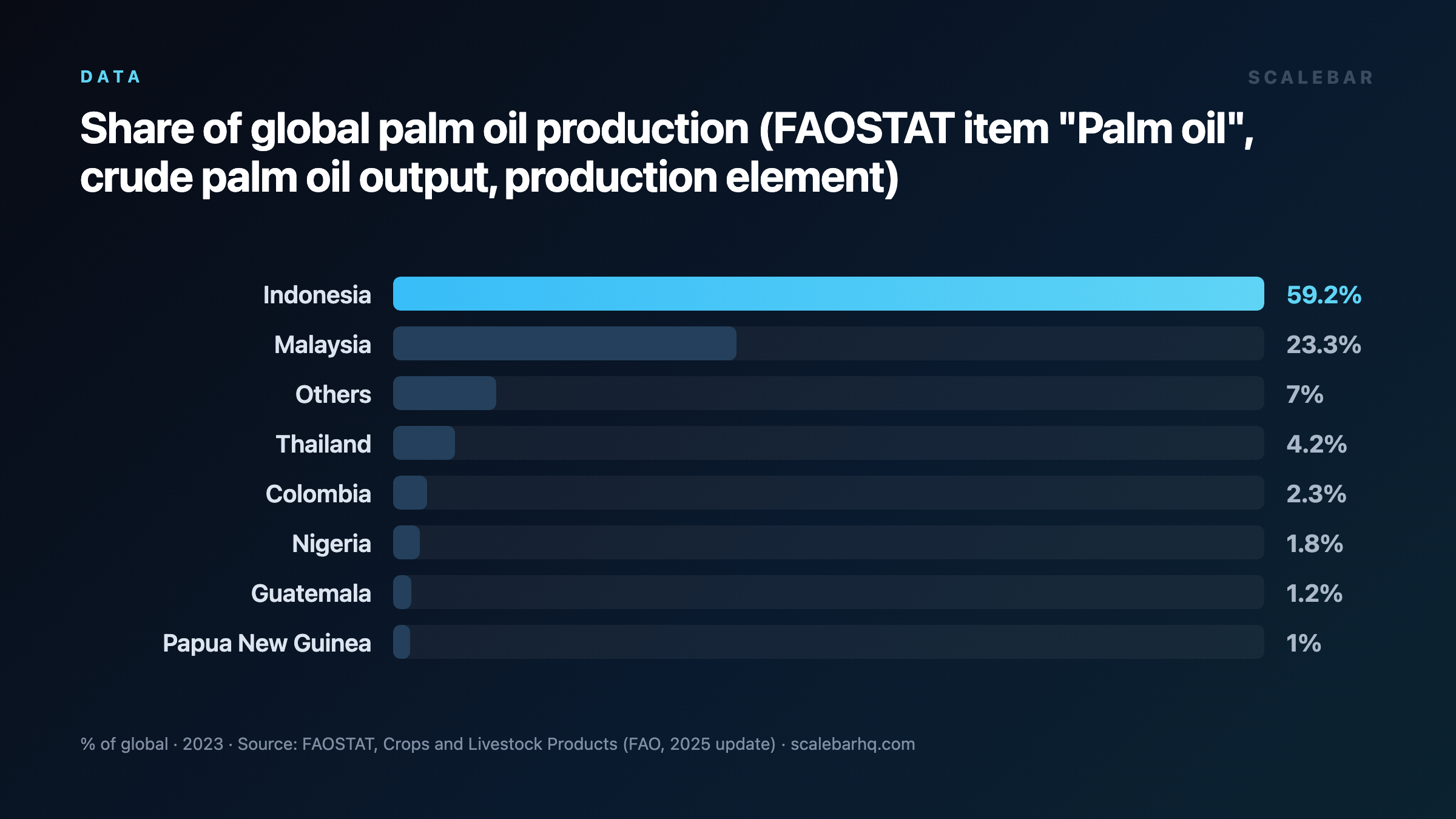
Together, Indonesia and Malaysia produce over 80% of global palm oil. This overwhelming market share represents a virtual duopoly over one of the world's most critical agricultural ingredients. Indonesia stands as the undisputed leader in this sector, accounting for roughly 54% of the global palm oil supply. Malaysia follows as the second-largest producer, contributing about 25% of the global supply.
The combined output of these two neighboring Southeast Asian nations dictates global market prices, trade flows, and supply stability. Because they control such a massive share of the market, any domestic policy shifts, trade negotiations, or environmental factors within these two countries immediately reverberate through global supply chains.
The Steep Production Drop-off
To understand the sheer scale of this concentration, one must look at the dramatic drop-off in production outside of the top two nations. While multiple countries cultivate oil palms commercially, their outputs are marginal by comparison. The gap between the second-place producer and the rest of the world is enormous.
Thailand, the world's third-largest producer, accounts for just 5% of global palm oil output. Colombia, the leading producer in the Americas, contributes a mere 2% to 3% of global palm oil output. This steep decline highlights the unique geographic, climatic, and economic factors that have anchored the industry so firmly in Southeast Asia. No other region has managed to scale production to a level that could challenge the dominant players.
Indonesia's Agricultural Footprint
The physical scale of production required to maintain this market dominance is immense. Indonesia alone has roughly 16 million hectares of palm oil under cultivation. This vast expanse of land is dedicated to a single crop, underpinning Indonesia's position as the world's top producer.
Managing and maintaining 16 million hectares of cultivation requires massive infrastructure, labor, and capital. This established agricultural footprint represents a significant structural barrier to entry for other nations, making it highly unlikely that any competitor will close the gap in the near future.
The Efficiency Engine
Why has palm oil achieved such dominance, now meeting about 40% of all vegetable oil consumed globally? The answer lies in its extraordinary agricultural efficiency. When compared to alternative oilseed crops, the oil palm is an unrivaled powerhouse of productivity.
- Palm Oil: Yields about 3.8 tonnes of oil per hectare.
- Sunflower: Yields roughly 1.2 tonnes of oil per hectare.
- Rapeseed: Yields around 0.8 tonnes of oil per hectare.
- Soybean: Yields about 0.4 tonnes of oil per hectare.
This yield gap is profound. To produce the same volume of oil as a single hectare of oil palm, a farmer would need nearly three times as much land for sunflowers, nearly five times as much land for rapeseed, and almost ten times as much land for soybeans. This unmatched land-use efficiency is the primary reason why palm oil has captured such a massive share of the global market, making it economically indispensable to multinational corporations and consumers alike.
Geopolitical and Economic Implications
The combination of high efficiency and extreme geographic concentration creates a unique geopolitical landscape. Because palm oil meets about 40% of all vegetable oil consumed globally, any disruption within the borders of Indonesia or Malaysia has immediate, cascading effects on global food security and consumer goods manufacturing.
Policy decisions, export regulations, labor dynamics, or weather anomalies in these two nations can trigger rapid price spikes and supply shortages worldwide. This gives Indonesia and Malaysia significant geopolitical leverage on the international stage, as global supply chains remain fundamentally dependent on their domestic agricultural outputs.
Frequently asked
- Which countries produce the majority of the world's palm oil?
- Indonesia and Malaysia dominate global production, together producing over 80% of the world's palm oil. Individually, Indonesia accounts for roughly 54% of the global supply, while Malaysia accounts for about 25%.
- How much palm oil is produced globally each year, and what share of the vegetable oil market does it hold?
- Global palm oil output is approximately 80 million tonnes produced every year worldwide. This highly efficient crop meets about 40% of all vegetable oil consumed globally.
- Why is palm oil preferred over other vegetable oils like soybean or rapeseed?
- Palm oil is exceptionally efficient, yielding about 3.8 tonnes of oil per hectare. In comparison, sunflower yields roughly 1.2 tonnes per hectare, rapeseed yields around 0.8 tonnes per hectare, and soybean yields about 0.4 tonnes per hectare.
- What are the next largest palm oil producers after Indonesia and Malaysia?
- The gap between the top two producers and the rest of the world is immense. Thailand is the third-largest producer, accounting for 5% of global palm oil output, while Colombia produces between 2% and 3% of the global output.
- How much land does Indonesia dedicate to palm oil cultivation?
- Indonesia has roughly 16 million hectares of palm oil under cultivation, a massive agricultural footprint that supports its position as the world's leading producer.
Sources
- https://www.proterrafoundation.org/wp-content/uploads/2024/02/proterra_the-2024-Non-GMO-Crop_01a-3-07-02.pdf
- https://www.sunflowernsa.com/uploads/38/2023sunflowercropqualityreport.pdf
- https://bepi.mpob.gov.my/images/overview/Overview2023.pdf
- https://trase.earth/insights/indonesian-palm-oil-exports-and-deforestation
- https://farming.org.ua/Sunflower%20yield%20per%20acre,%20sunflower%20yield%20per%20hectare.html
- https://www.bbvaresearch.com/en/publicaciones/colombia-palm-oil-a-promising-bet-for-the-future
- https://m.palmoilextractionmachine.com/FAQ/palm_oil_processing_equipment_1120.html
- https://www.researchgate.net/publication/383075230_Current_status_of_Indonesia's_palm_oil_products_and_their_competitiveness_in_the_global_market
- https://www.sei.org/features/indonesian-palm-oil-exports-and-deforestation/, https://www.indonesia-investments.com/business/commodities/palm-oil/item166, https://globalcanopy.org/insights/insight/indonesian-palm-oil-exports-and-deforestation/, https://www.undp.org/foodsystems/indonesia-sustainable-palm-oil
- https://news.mongabay.com/2023/09/palm-oil-giants-indonesia-malaysia-start-talks-with-eu-over-deforestation-rule
- https://resiliencebv.com/wp-content/uploads/2024/08/20240925_Palm-Oil_Colombia.pdf
- https://www.iisd.org/publications/report/2023-global-market-report-palm-oil
- https://www.reportlinker.com/dataset/4df5b994d0b6704145efec21fe881a20416b7a4f
- https://www.sustainablepalmoilchoice.eu/more-facts/
- https://www.researchgate.net/publication/394520137_PALM_OIL_TRADE_VOLUME_IN_THE_WORLD_AND_IN_TURKIYE
- https://goldenagri.com.sg/wp-content/uploads/2019/01/Oil-palm-is-the-most-productive-vegetable-oil.pdf
- https://www.fwi.co.uk/arable/harvest/harvest-2023-some-good-oilseed-rape-yields-but-most-are-down
- https://www.sustainablepalmoilchoice.eu/more-facts
- https://www.sciencedirect.com/science/article/abs/pii/S1462901124000054
- https://www.facebook.com/pulsenigeria247/posts/two-countries-indonesia-and-malaysia-led-the-top-five-palm-oil-producing-countri/871381428362969
- https://www.researchgate.net/publication/392140856_Comparative_Study_of_Crude_Palm_Oil_Exports_to_The_Main_Producing_Countries_in_Asean