Two Countries Supply Most of the World's Platinum
With South Africa and Russia dominating global output, the supply chain for this critical precious metal is one of the most vulnerable on Earth.
Two Countries Supply Most of the World's Platinum
In the global trade of natural resources, few commodities exhibit the extreme geographic concentration of platinum. While industrial metals like copper and iron are mined across multiple continents, platinum is confined to a remarkably select group of nations.
Platinum is rarer than gold, and its global supply chain is exceptionally fragile. South Africa and Russia together control the overwhelming majority of global platinum supply, making this metal one of the most geographically concentrated resources on Earth. Any disruption within these borders has immediate, far-reaching consequences for global manufacturing, green technology, and automotive industries.
---
The Scale of Global Platinum Production
To understand the vulnerability of the platinum market, one must first understand its scale. Unlike industrial metals mined by the millions of tons, the global output of platinum is measured in mere metric tons. On average, the world produces roughly 170 to 190 metric tons of platinum per year (with some annual estimates narrowing the band to between 170 and 180 metric tons).
Because the total physical volume of platinum extracted annually is so small, even minor fluctuations in mining output can trigger significant market deficits. This scarcity amplifies the influence of the few nations that possess extractable reserves.
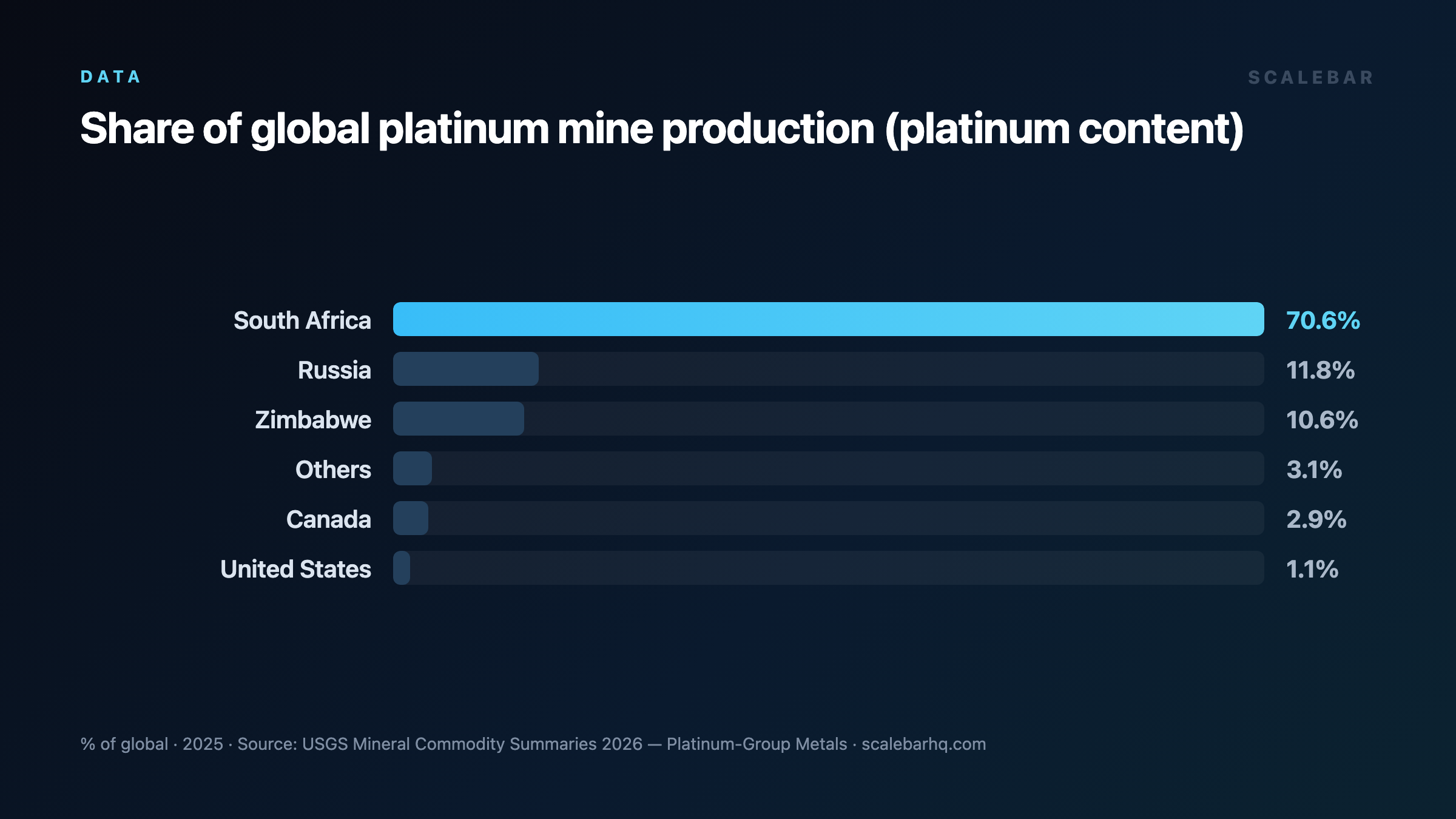
``` Global Platinum Production by Country (Approximate Annual Metric Tons)
South Africa: ██████████████████████████████ 124 (2022) Russia: █████ 22 Zimbabwe: ████ 18 Canada: █ 5 United States: 3 ```
---
South Africa’s Unrivaled Hegemony
South Africa sits at the absolute center of the platinum universe. The country produces between 70 and 80 percent of the world's mined platinum output. To put this dominance into perspective, South Africa contributed roughly 124 metric tons of platinum in 2022 alone.
This level of concentration is virtually unmatched in global mining. It grants South Africa immense economic leverage but also introduces a single point of failure for global industries. Platinum mining is highly energy-intensive and relies on deep underground operations. Consequently, domestic challenges in South Africa—ranging from labor strikes to systemic electrical power cuts—directly threaten the global supply. When South African mines slow down, the global industrial sector immediately feels the squeeze.
---
Russia and Zimbabwe: The Supporting Giants
While South Africa is the undisputed leader, Russia and Zimbabwe serve as the remaining pillars of the global supply.
- Russia produces about 13 percent of global platinum, which translates to approximately 22 metric tons of platinum per year. This makes Russia the world's second-largest producer. Given current geopolitical tensions, Russia's significant share of the market introduces substantial supply-chain risks for Western nations relying on the metal for industrial applications.
- Zimbabwe occupies the third position, producing about 9 percent of global platinum, or approximately 18 metric tons per year.
Together, South Africa, Russia, and Zimbabwe control nearly the entire global market. Outside of these three nations, platinum mining is negligible. For instance, Canada produces approximately 5 metric tons of platinum per year, while the United States produces approximately 3 metric tons. These North American operations are vital for domestic security but represent a tiny fraction of global demand.
---
Where Does the Platinum Go?
Platinum is not merely a luxury asset for wealth preservation; it is a workhorse of modern industry. Its unique catalytic properties and high melting point make it irreplaceable in several key sectors.
1. Autocatalysts (40% of End Uses)
Autocatalysts, or catalytic converters, account for approximately 40% of platinum end uses. Installed in vehicle exhaust systems, these devices use platinum to convert toxic engine emissions into less harmful gases. As emissions regulations tighten globally, demand for platinum in the automotive sector remains robust.
2. Jewelry (25% of End Uses)
Jewelry accounts for approximately 25% of platinum end uses. Valued for its purity, resistance to tarnish, and bright white luster, platinum is a highly coveted metal in luxury retail markets worldwide.
3. Industrial and High-Tech Applications (20% of Demand)
Industrial uses account for approximately 20% of platinum demand. This category includes critical medical devices, such as pacemakers and specialized surgical tools, as well as chemical manufacturing equipment. Furthermore, platinum is a foundational component in hydrogen fuel cells, positioning it as a critical material for the transition to clean energy.
---
A Highly Sensitive Supply Chain
The extreme geographic concentration of platinum production means that the global transition to clean energy and the stability of the automotive sector are heavily dependent on the political and economic stability of just two nations: South Africa and Russia.
With South Africa producing up to 80 percent of the supply and Russia contributing another 13 percent, over nine-tenths of the world's platinum originates from countries facing unique domestic and geopolitical challenges. For global manufacturers, securing a stable supply of this rare metal remains one of the most complex logistical hurdles of the modern era.
Frequently asked
- Which country produces the most platinum?
- South Africa is the world's dominant platinum producer, accounting for between 70 and 80 percent of global mined output. In 2022, South Africa contributed roughly 124 metric tons of platinum.
- How much platinum is produced globally each year?
- The world produces roughly 170 to 190 metric tons of platinum per year, making it significantly rarer than gold.
- What are the primary industrial uses of platinum?
- The largest end use for platinum is in autocatalysts (catalytic converters), which account for approximately 40% of its use. Jewelry accounts for about 25%, and other industrial applications—including medical devices and hydrogen fuel cells—account for approximately 20% of global demand.
- How much platinum do Russia and the United States produce?
- Russia produces approximately 22 metric tons of platinum per year (about 13 percent of the global total), making it the second-largest producer. In contrast, the United States produces a minor share of approximately 3 metric tons per year.
Sources
- https://statbase.org/datasets/metals/platinum-production
- https://www.statista.com/statistics/273624/platinum-metal-reserves-by-country/
- https://platinuminvestment.com/about/demand-drivers
- https://www.globaldata.com/data-insights/mining/production-of-platinum-in-zimbabwe-1092526
- https://www.ebsco.com/research-starters/science/south-africa-and-mining
- https://www.theglobaleconomy.com/Canada/Canada/platinum_production
- https://www.mining-technology.com/data-insights/platinum-in-russia/
- https://www.theglobaleconomy.com/Russia/platinum_production
- https://www.facebook.com/africaishome2/posts/south-africa-leads-global-platinum-production-supplying-75-of-the-worlds-output/1369016617919232
- https://www.mining-technology.com/data-insights/platinum-in-russia
- https://www.statista.com/statistics/1170691/mine-production-of-platinum-worldwide/
- https://www.theglobaleconomy.com/South-Africa/platinum_production
- https://www.mining-technology.com/analyst-comment/global-platinum-output-south-africa/
- https://learn.apmex.com/learning-guide/bullion/how-rare-is-platinum
- https://equityaxis.net/post/18426/2025/5/zimbabwe-s-platinum-output-drops-13-in-q1-2025-insights-into-latest-global-platinum-outlook
- https://www.investing.com/analysis/platinum-to-stay-in-drivers-seat-for-2023-palladium-in-rearview-200634461
- https://clientportal.jpx.co.jp/jpxjoinEN/s/news/platinum-jewellery-demand-20240105-commodities-MC34WFX2W35FE5DC6DNZH2XH6MC4
- https://finance.yahoo.com/news/global-platinum-mining-industry-report-084500483.html
- https://www.theglobaleconomy.com/USA/platinum_production
- https://worldpopulationreview.com/country-rankings/platinum-production-by-country
- https://www.mining-technology.com/features/platinum-mining-in-uncertain-time/
- https://natural-resources.canada.ca/minerals-mining/mining-data-statistics-analysis/minerals-metals-facts/platinum-facts
- https://www.statista.com/statistics/1175466/global-platinum-group-metal-reserves/