Two Countries Supply Most of the World's Rubber
Thailand and Indonesia control over 57% of the world's natural rubber supply, leaving global industries highly dependent on a single region.
The modern global economy relies on a complex web of supply chains, but few are as geographically concentrated—or as vital—as the market for natural rubber. From the tires that keep global logistics moving to the sterile gloves used in hospitals and the components inside consumer electronics, natural rubber is an irreplaceable raw material. While synthetic alternatives exist, they cannot fully match the physical properties of the natural product, such as its superior heat dispersion and elasticity. Consequently, the world remains deeply dependent on a highly localized agricultural sector. Specifically, a massive portion of the global supply originates from just two Southeast Asian nations: Thailand and Indonesia. Together, these two countries control the majority of the global natural rubber supply, creating a critical bottleneck for global manufacturing.
The Southeast Asian Duopoly
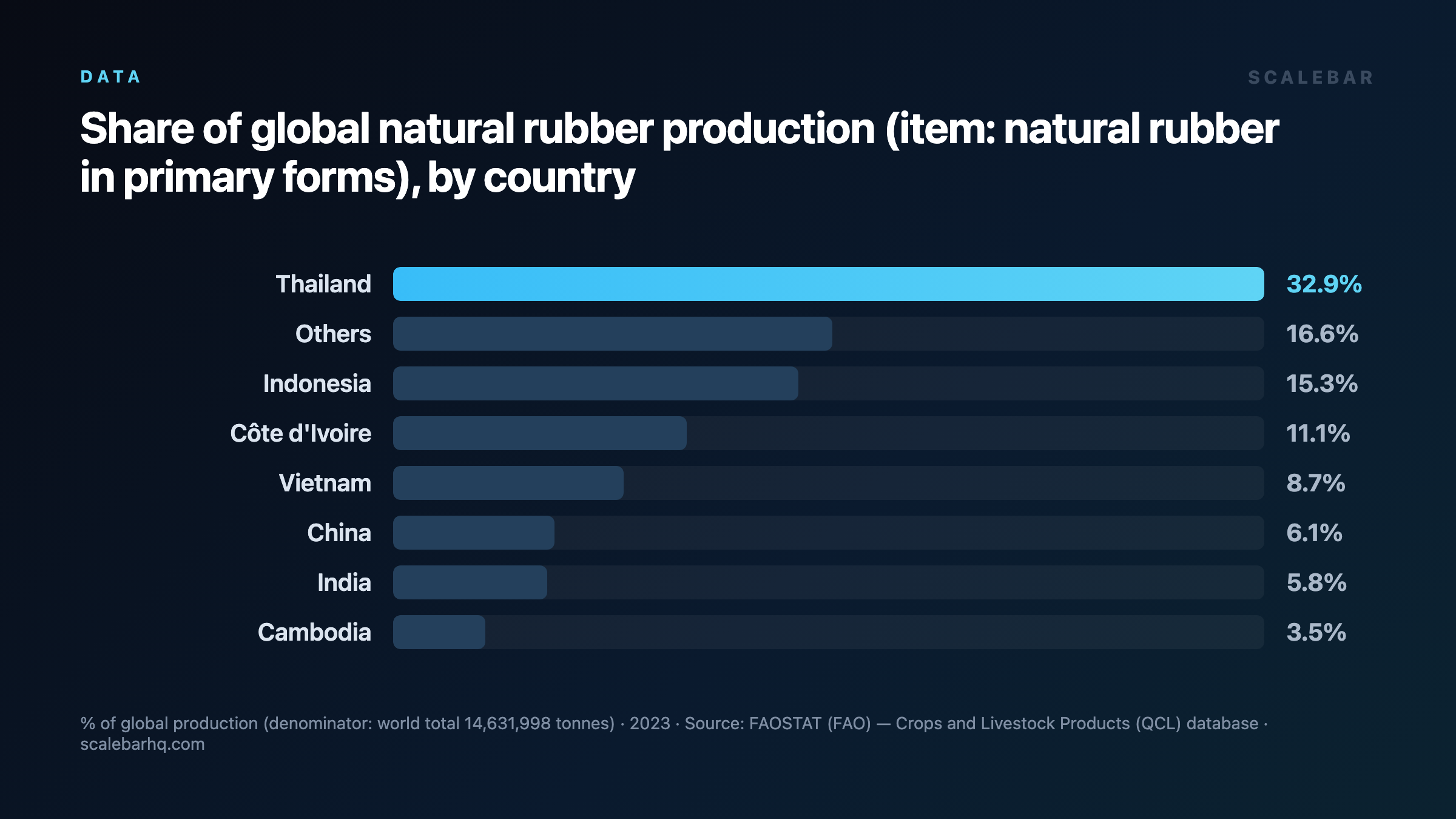
To understand the scale of this concentration, one only needs to look at the production data. Globally, natural rubber production runs at around 14 to 15 million metric tons a year. Out of this global total, Thailand and Indonesia together account for over 57% of all natural rubber produced on Earth.
Thailand stands as the undisputed leader of the industry, producing 33% of the global natural rubber output. Indonesia follows closely behind, contributing 25% of the global total. This means that more than one out of every two tons of natural rubber harvested worldwide comes from these two neighboring nations. If agricultural pests, political instability, or extreme weather events affect this region, the shockwaves are felt instantly across global manufacturing sectors.
The Rest of the Global Landscape
Beyond the top two giants, the drop-off in production capacity is steep. Vietnam occupies the third position in global rankings, but it remains far behind the market leaders. Vietnam produces 9% of global natural rubber output. While Vietnam is a significant regional player, its output is less than a third of Thailand's and does not come close to challenging the duopoly of the top two producers. Beyond Vietnam, the global market becomes highly fragmented, with smaller producers scattered across tropical regions, none of which possess the infrastructure or land area to match the output of Thailand or Indonesia.
The Smallholder Backbone
One of the most surprising aspects of the natural rubber supply chain is its organizational structure. While many global commodities—such as palm oil or soy—are dominated by massive, multinational corporate plantations, natural rubber relies on a highly decentralized network of individual producers. About 85% of rubber trees are grown on small family farms rather than giant corporate estates.
This means that millions of smallholder farmers are the true backbone of a supply chain that reaches every hospital and highway on the planet. These farmers manually tap the rubber trees, collecting the liquid latex day after day. This decentralized structure has profound economic implications. It means that the global supply of this critical raw material is highly sensitive to the economic well-being, local weather conditions, and agricultural practices of individual families. While this model supports millions of rural livelihoods across Southeast Asia, it also introduces unique challenges in terms of supply chain traceability, quality standardization, and sustainability initiatives.
The Scale of Cultivation: Indonesia's Footprint
The physical scale of rubber farming in Southeast Asia is difficult to overstate. In Indonesia alone, there are roughly 3.67 million hectares under rubber cultivation. This represents an agricultural footprint dedicated almost entirely to a single crop. This vast expanse of land is managed primarily by smallholders, reflecting the deep integration of rubber cultivation into the rural economy of the Indonesian archipelago. The sheer land area required to sustain global demand highlights why other regions cannot easily replicate or replace the production capacity of Southeast Asia.
Natural vs. Synthetic Rubber
To understand why natural rubber remains so critical, it is helpful to examine its share of the broader rubber market. Globally, rubber usage is split between natural and synthetic varieties. Synthetic rubber, which is derived from petrochemicals, accounts for 52% to 58% of all rubber used worldwide. Natural rubber makes up roughly 48% of all rubber used worldwide.
Despite the dominance of synthetic rubber in certain industrial applications, natural rubber remains irreplaceable for high-stress applications. For example, airplane tires, heavy-duty truck tires, and highly flexible medical equipment require the superior tensile strength, tear resistance, and heat-dispersion properties of natural rubber. As a result, industrial manufacturing cannot simply substitute synthetic rubber for natural rubber if supply chains fail.
Global Trade Flows and Export Destinations
The rubber harvested in Southeast Asia feeds directly into major industrial economies. Thailand, as the world's largest producer, exports its rubber to key manufacturing hubs across Asia and the globe. China serves as the single biggest buyer of Thai natural rubber, importing a massive portion of Thailand's exports to fuel its domestic automotive and manufacturing industries. Another critical destination is Malaysia, which accounts for 11% of Thai rubber exports. Malaysia's high import volume is driven in part by its own massive medical glove and rubber product manufacturing industries, which process raw latex into finished goods for global distribution.
Conclusion
The global reliance on Thailand and Indonesia for natural rubber highlights a profound vulnerability in modern supply chains. With over 57% of the world's natural rubber originating from these two nations—and largely produced by millions of smallholder farmers—the stability of global transportation, healthcare, and electronics manufacturing rests on a remarkably concentrated geographic foundation.
Frequently asked
- Which countries produce the most natural rubber?
- Thailand and Indonesia are the world's leading producers, together accounting for over 57% of global natural rubber output. Individually, Thailand produces 33% and Indonesia produces 25% of the global supply. Vietnam is the third-largest producer, accounting for 9% of global output.
- How much natural rubber is produced globally each year?
- Global natural rubber production runs at around 14 to 15 million metric tons per year.
- Who actually grows the world's rubber trees?
- Unlike many industrial crops, about 85% of rubber trees are grown on small family farms rather than large corporate plantations.
- How much land is dedicated to rubber farming in Indonesia?
- Indonesia has roughly 3.67 million hectares of land under rubber cultivation.
- What is the market split between natural and synthetic rubber?
- Natural rubber makes up roughly 48% of all rubber used worldwide, while synthetic rubber accounts for 52% to 58% of global rubber consumption.
Sources
- https://rubberboard.gov.in/rbfilereader?fileid=1166
- https://www.grandviewresearch.com/industry-analysis/rubber-market-report
- https://partnershipsforforests.com/resources/advancing-smallholder-farmers-voices-in-the-global-platform-for-sustainable-natural-rubber
- https://mkresourcesgovernance.org/wp-content/uploads/2025/04/20250418_Brief_Rubber-workshop_EN.pdf
- https://www.rubis-project.org/project-events/rubis-project-kick-off-meeting/wp1
- https://www.globlex.co.th/research/research_24679_1_20241127%20THAILAND%20RUBBER_EN.pdf
- https://wifitalents.com/natural-rubber-industry-statistics/
- https://www.indonesia-investments.com/business/commodities/rubber/item185, https://www.krungsri.com/en/research/industry/industry-outlook/agriculture/rubber/io/rubber-2025-2027
- https://www.indonesia-investments.com/business/commodities/rubber/item185
- https://www.helgilibrary.com/charts/which-country-produces-the-most-natural-rubber/
- https://www.linkedin.com/pulse/thailands-june-natural-rubber-exports-jump-228-jom-jacob
- https://www.nature.com/articles/s41586-023-06642-z
- https://iopscience.iop.org/article/10.1088/1755-1315/1526/1/012027/pdf
- https://www.anrpc.org/news/top-10-rubber-producing-countries-(2025)
- https://www.statista.com/statistics/275387/global-natural-rubber-production