One Country Grows 90% of the World's Most Expensive Spice
How a single region in Iran controls the global supply of the world's most expensive spice.
One Country Grows 90% of the World's Most Expensive Spice
Saffron is widely recognized as the most expensive spice on the planet. Fetching prices of up to $10,000 per kilogram, it is a luxury commodity that rivals precious metals in value. The global saffron market is worth hundreds of millions to over one billion dollars, reflecting its widespread demand in culinary, cultural, and medicinal applications. Yet, despite this massive financial footprint, the physical volume of the trade is remarkably small. Total global saffron production is roughly 400 tonnes per year. This striking disparity between low physical volume and high economic value is a direct result of the spice's painstaking production process and its extreme geographic concentration.
The Anatomy of a Labor-Intensive Harvest
To understand why saffron commands up to $10,000 per kilogram, one must look at the agricultural process. Saffron is derived from delicate flowers, and the harvest is entirely manual, requiring an extraordinary amount of human labor. It takes roughly 150 flowers to produce just one single gram of saffron. This means that to produce a single kilogram, hundreds of thousands of flowers must be individually harvested and processed.
Furthermore, the timing of the harvest is incredibly sensitive. Saffron flowers must be hand-picked at dawn before the petals open. Once the sun rises and the petals expand, the delicate parts are exposed to the elements, which can rapidly degrade their quality. Because of these strict botanical requirements, there is no shortcut to mechanize the harvest. Every thread of saffron represents hours of meticulous manual labor, performed during a very narrow daily window.
Iran's Agricultural Hegemony
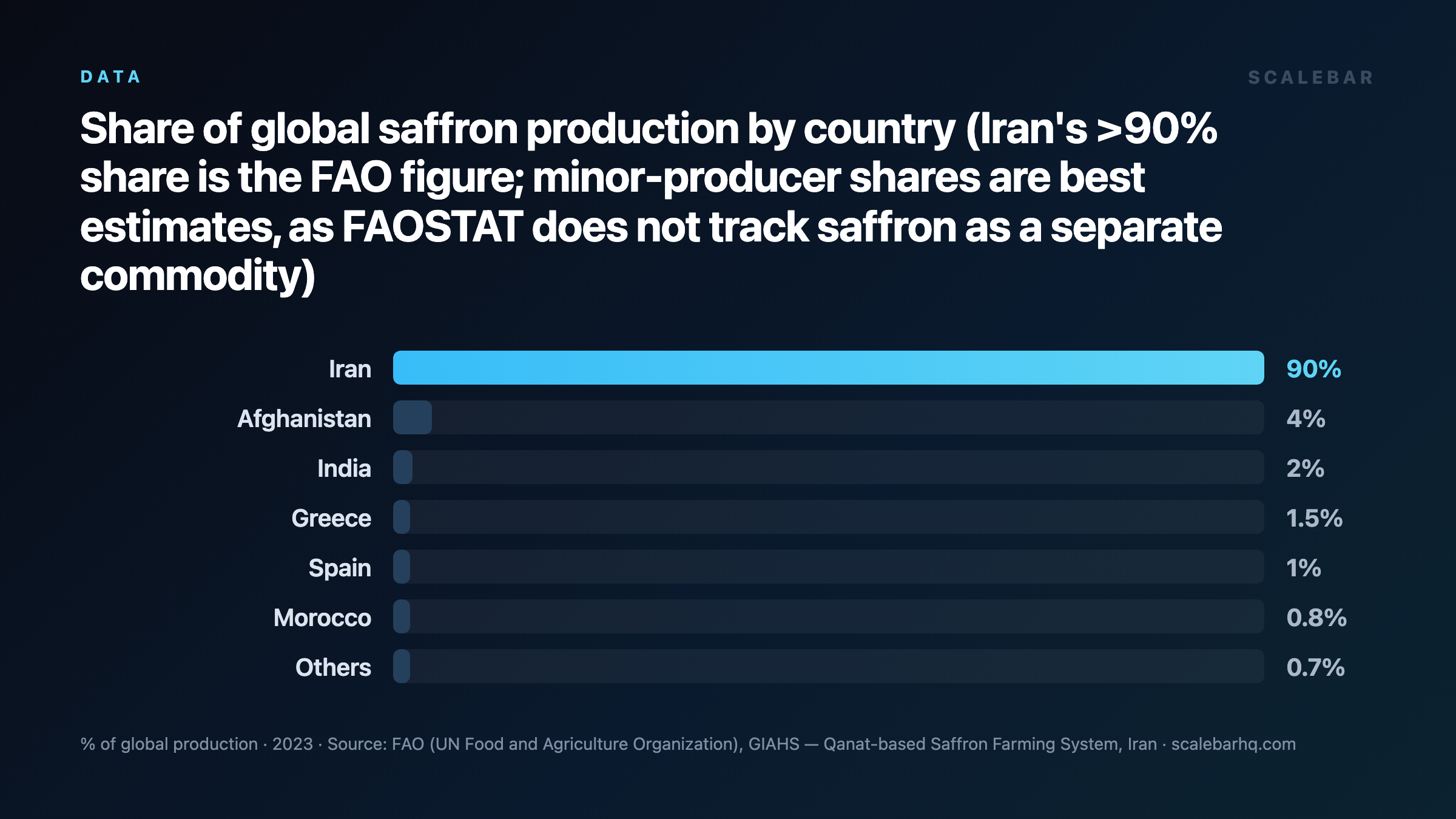
While saffron can theoretically be grown in various parts of the world, the global supply chain is dominated by a single nation. Iran produces 90% of the world's saffron (with some data indicating about 90%). This near-total monopoly makes saffron one of the most concentrated agricultural supply chains on Earth.
The heartland of this production is the Khorasan region in Iran. Khorasan possesses a unique combination of environmental and cultural factors that make it the ideal environment for saffron cultivation. The region's dry climate provides the exact conditions the flowers need to thrive. Beyond the climate, Khorasan is home to farmers who possess ancient farming knowledge. This traditional expertise, passed down through generations, covers everything from soil preparation to the precise timing of harvesting. This combination of ideal geography and deep-seated agricultural heritage makes Iran's scale of production nearly impossible to replicate elsewhere.
The Global Landscape and Alternative Producers
Although Iran dominates the market, other nations play notable roles in the global trade, albeit on a much smaller scale. Afghanistan produces 23% of the world's saffron. The country's similar climate and geography have allowed it to establish a foothold in the high-value market. Meanwhile, Spain produces about 2% of the world's saffron, maintaining a historic connection to the spice's trade.
Other producers exist, but their output is minimal compared to the dominant players. The presence of these alternative producers highlights the global demand for the spice, yet none of them possess the output capacity to challenge Iran's market dominance.
The Risks of Extreme Concentration
The extreme concentration of the saffron supply chain in Iran presents significant risks to the global market. When 90% of a global commodity originates from a single country—and is heavily concentrated within a specific region like Khorasan—the entire supply chain becomes highly vulnerable to localized disruptions.
Geopolitical factors, such as sanctions, can severely restrict Iran's ability to export its harvest. Environmental factors pose an even more immediate threat. Saffron is highly sensitive to weather patterns. A severe drought or a bad harvest in just one Iranian province can drastically reduce the global supply. Because there is no alternative producer capable of making up for a major shortfall in Iranian production, any disruption in Khorasan can move global saffron prices overnight, creating volatility for buyers, distributors, and consumers worldwide.
Conclusion
The global saffron trade is a fascinating study in agricultural economics and geography. It is a market where ancient traditions, intense manual labor, and specific climatic conditions converge to produce a commodity of immense value. With global production limited to roughly 400 tonnes per year and prices reaching up to $10,000 per kilogram, saffron remains a symbol of luxury. However, as long as Iran produces 90% of the world's supply, the market will remain one of the most concentrated and fragile agricultural supply chains on Earth, subject to the whims of geopolitics, climate, and the delicate timing of a dawn harvest.
Frequently asked
- Why is saffron the most expensive spice in the world?
- Saffron costs up to $10,000 per kilogram because of its highly labor-intensive harvesting process. It takes roughly 150 flowers to produce just one gram of saffron, and the flowers must be hand-picked at dawn before the petals open.
- Which country dominates global saffron production?
- Iran dominates the global market, producing 90% (or about 90%) of the world's saffron. The heartland of this production is Iran's Khorasan region.
- What is the total volume and value of the global saffron market?
- Total global saffron production is roughly 400 tonnes per year, and the global saffron market is worth between hundreds of millions to over one billion dollars.
- What other countries produce saffron besides Iran?
- While Iran is the primary producer, Afghanistan produces 23% of the world's saffron, and Spain produces about 2%.
Sources
- https://arccjournals.com/journal/agricultural-reviews/RF-290
- https://www.researchgate.net/publication/382561403_Analysis_of_the_global_research_trend_of_saffron_Crocus_sativus_L_between_2000-2023
- https://www.gminsights.com/industry-analysis/saffron-market
- https://www.rhs.org.uk/herbs/saffron
- https://en.wikipedia.org/wiki/Saffron
- https://www.marketreportsworld.com/market-reports/organic-saffron-market-14717816
- https://iranopendata.org/en/article/257-iran-saffron-slump-from-world-leader-to-bulk-supplier/, https://www.marketresearch.com/StatLedger-Market-Research-Consulting-v4317/Iran-Saffron-Trend-Forecast-40576646/, https://en.wikipedia.org/wiki/Saffron_trade
- https://iranopendata.org/en/article/257-iran-saffron-slump-from-world-leader-to-bulk-supplier
- https://www.researchgate.net/publication/282991292_THE_ECONOMICS_OF_SAFFRON_IN_IRAN
- https://www.goldensaffron.com/blog/Saffron/saffron-producer-countries
- https://oec.world/en/profile/bilateral-product/saffron/reporter/afg
- https://www.quora.com/How-expensive-is-saffron-in-the-USA
- https://iranopendata.org/en/article/257-iran-saffron-slump-from-world-leader-to-bulk-supplier/
- https://www.rocosaffron.com/blogs/saffron-hub/saffron-harvesting-precision-timing-and-tradition
- https://india.mongabay.com/2024/04/indoor-saffron-farming-offers-hope-amidst-declining-saffron-production/
- https://www.reddit.com/r/todayilearned/comments/7imomv/til_that_it_takes_roughly_150_flowers_to_yield_1/
- https://www.india.mongabay.com/2024/04/indoor-saffron-farming-offers-hope-amidst-declining-saffron-production/
- https://saffronica.ir/saffron-and-numbers/, https://www.reddit.com/r/todayilearned/comments/7imomv/til_that_it_takes_roughly_150_flowers_to_yield_1/, https://www.uvm.edu/~saffron/Old/Workshops/Saffron%20Workshop%202020/Saffron%20by%20the%20numbers%202020.pdf, https://projects.sare.org/project-reports/os23-166/, https://en.wikipedia.org/wiki/Saffron