One Country Produces Over Half the World's Cashews
West Africa grows more than half of the world's cashews, but a lack of local processing means Asian factories capture the real profits.
The global snack industry is a highly lucrative market, and at the heart of this trade is the cashew. Highly prized for its taste, nutritional profile, and versatility, the cashew has transitioned from a niche luxury to a mainstream dietary staple across the globe. Yet, behind the neatly packaged containers lining supermarket shelves in North America and Europe lies a highly unequal global supply chain. A single coastal strip of West Africa quietly dominates the global cashew supply chain, yet captures almost none of the profit. This geographic disconnect between where the raw agricultural commodity is grown and where it is processed highlights a classic economic challenge faced by developing nations: the struggle to move up the global value chain.
The Geography of Production
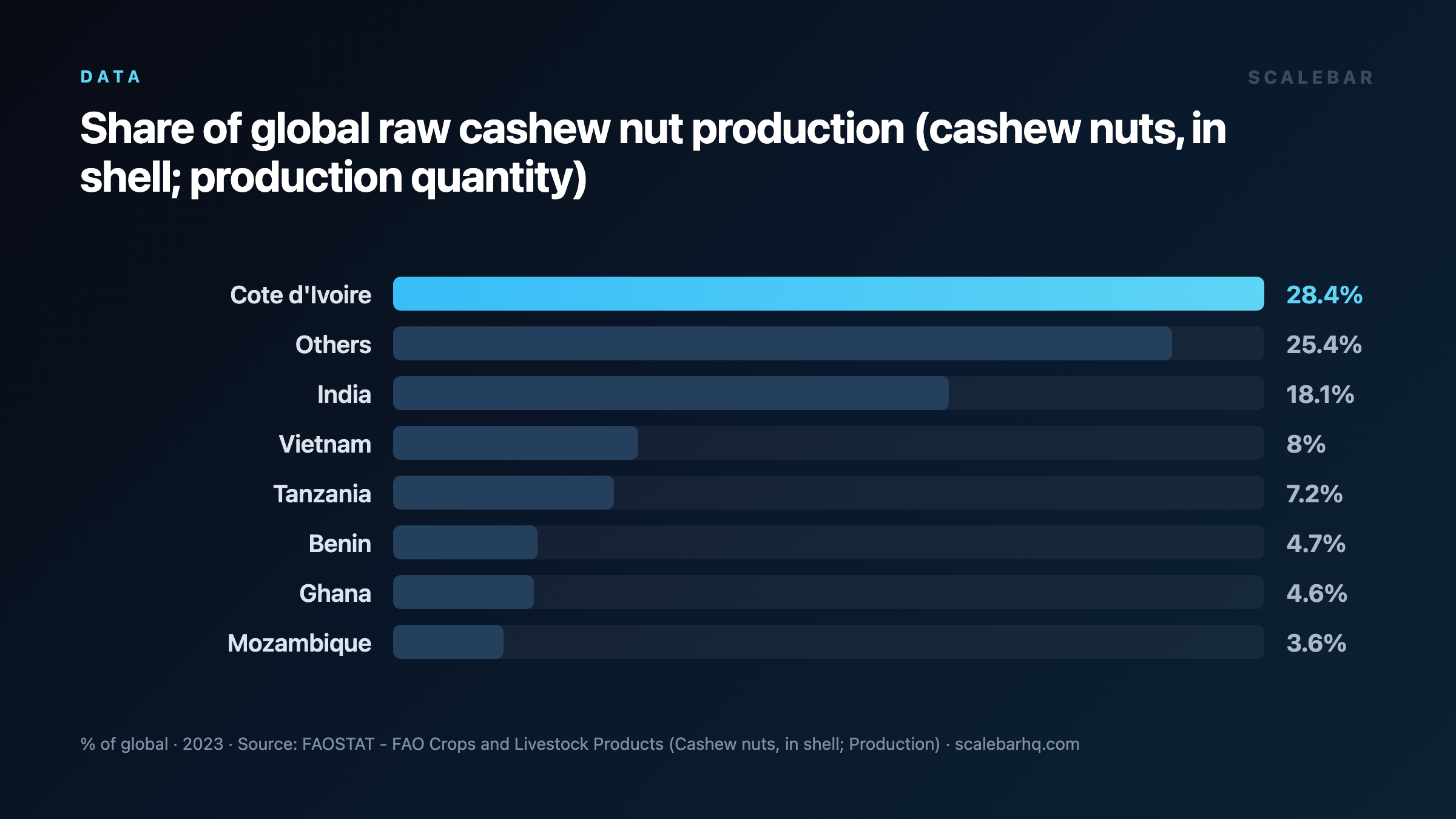
To understand the scale of this industry, one must look at the agricultural map of cashew cultivation. West Africa has emerged as the undisputed heavyweight of global cashew cultivation. Today, West Africa grows more than half of all cashews on Earth. Within this region, the Ivory Coast stands out as the dominant force, accounting for roughly 40 percent of world cashew output. Other nations in the region, such as Guinea-Bissau, also play significant roles in the regional agricultural landscape.
Outside of West Africa, other major global producers include Vietnam, which accounts for 36 percent of world cashew output, and India, which accounts for 18 percent of the global total. Further south on the African continent, Tanzania accounts for 4 percent of world cashew output. While these figures demonstrate a highly concentrated production landscape, they only tell half the story. The true economic divide emerges not in the orchards where the nuts are harvested, but in the industrial facilities where they are prepared for consumption.
The Processing Bottleneck
The journey of a cashew from a tropical tree to a consumer-ready snack is complex. The raw cashew nut grows beneath a fleshy accessory fruit known as the cashew apple. Harvesting the nut is only the first step; the raw nut is encased in a tough, caustic shell that must be carefully removed, roasted, and peeled before it is safe and palatable for human consumption. This processing stage is where the vast majority of the economic value is created.
However, West Africa currently lacks the industrial infrastructure required to process its own harvest. Consequently, about 90 percent of West African cashews are shipped raw to Asia before they undergo any processing. This massive maritime transfer of raw agricultural goods represents a significant transfer of economic potential. Instead of generating local manufacturing jobs and industrial expertise within West African nations, the raw nuts are loaded onto container ships and sent thousands of miles away.
The Economics of Value Addition
The financial disparity between raw agricultural exports and processed goods is stark. On the global market, a raw cashew sells for roughly one dollar per kilogram. This farmgate price represents a fraction of the final retail value. Once the raw nut is shipped to Asia, processed, packaged, and distributed to retail markets, the price paid by the end consumer is several times higher than what the original farmer received.
The countries that dominate this high-value processing stage are Vietnam and India. Vietnam processes 36 percent of global cashews, leveraging highly automated processing facilities to maintain its position at the top of the value chain. India is also a major processing hub, responsible for processing 20 percent of global cashews. By importing raw nuts from West Africa, processing them domestically, and exporting the finished product, these Asian nations capture the bulk of the value-added profits. The West African farmers who do the heavy lifting of cultivation and harvesting are left with the lowest-margin segment of the business.
The Push for Industrialization
Recognizing this economic imbalance, West African governments are actively pushing to build domestic processing capacity. The goal is to transition from being a mere exporter of raw commodities to becoming an industrial hub that can process, package, and export finished cashew products directly to global markets.
This push is already reflected in the region's trade data. Between 2018 and 2021, the volume of cashew exports from West Africa experienced a dramatic upward trajectory. In 2018, West Africa cashew exports stood at 1.795 million tonnes. By 2021, this figure had climbed sharply to reach around 3 million tonnes. While a significant portion of these exports still consists of raw nuts destined for Asian processing plants, the rapid growth in volume underscores the region's expanding agricultural footprint and the urgent need for local processing infrastructure to match this output.
Building a domestic processing industry is not without its challenges. It requires substantial capital investment, reliable energy grids, skilled labor, and favorable trade policies. However, the potential rewards are immense. If West African nations can successfully scale up their domestic processing capabilities, they can retain a much larger share of the multi-billion dollar cashew market. The country growing the cashew might finally profit as much as the country roasting and packaging it, transforming the economic landscape of the entire region.
Frequently asked
- Which country produces the most raw cashews?
- Ivory Coast is the world's leading producer, accounting for roughly 40% of global cashew output.
- Where are most West African cashews processed?
- About 90% of West African cashews are shipped raw to Asia for processing, with Vietnam and India dominating this stage of the supply chain.
- How much does a raw cashew sell for compared to processed ones?
- A raw cashew sells for roughly one dollar per kilogram, which is a fraction of the final retail price of processed and packaged cashews.
- How much has West Africa's cashew export volume grown?
- West African cashew exports grew significantly from 1.795 million tonnes in 2018 to around 3 million tonnes in 2021.
Sources
- https://www.zatra.co/post/tanzania-cashew-industry-a-comprehensive-guide-for-investors
- http://www.africancashewalliance.com/en/news-and-info/cashew-news/cashew-processing-west-africa-51-2025-driven-cote-divoire, https://www.technoserve.org/blog/west-african-cashews-challenges-strategies/
- https://agriculture.institute/production-tech-fruit-crops/global-indian-cashew-production-insights/
- https://www.facebook.com/apnikhetii/posts/india-ranks-as-the-worlds-second-largest-cashew-producer-showcasing-its-signific/809731970947701
- https://rotterdamcommodity.com/west-africa-vietnam-and-cambodia-are-rewriting-the-cashew-map
- https://www.facebook.com/businessinsiderssa/posts/did-you-know-africa-produces-half-of-the-worlds-cashews/438619355391681
- https://vietnamnet.vn/en/vietnam-secures-nearly-all-of-cambodia-s-cashew-exports-with-1-billion-deal-2369317.html, https://www.mordorintelligence.com/industry-reports/vietnam-cashew-market, https://www.linkedin.com/pulse/vietnams-cashew-industry-sustaining-global-leadership-through-rejmc, https://www.youtube.com/watch?v=sI0BgxwgFw0, https://cashewinformation.com/documents/country-profiles/Vietnam-Country-Profile.pdf
- https://www.statista.com/statistics/1297203/cashew-nut-exports-from-africa-by-country
- https://www.mordorintelligence.com/industry-reports/vietnam-cashew-market
- https://www.worldbank.org/en/results/2025/04/15/agri-processing-adds-value-in-cote-d-ivoire-s-cashew-industry
- https://www.instagram.com/reel/DUidGm_gbP4?hl=en
- https://dccd.gov.in/pricing-trend-of-rawnut
- https://www.marketreportsworld.com/market-reports/cashew-market-14716236
- https://www.chelmerfoods.com/news/cashew-market-report-26-06-2023
- https://www.academia.edu/68663528/Trend_analysis_of_production_consumption_and_export_of_cashew_crop_in_West_Africa
- https://www.cbi.eu/sites/default/files/vca-cashew-west-africa_0.pdf
- https://www.researchgate.net/publication/400834886_Scaling_Up_the_Cashew_Nut_Market_Share_in_the_Global_Market_to_Enhance_Economic_Growth_in_Tanzania
- http://www.africancashewalliance.com/en/news-and-info/cashew-news/cashew-processing-west-africa-51-2025-driven-cote-divoire
- https://special.vietnamplus.vn/2023/11/20/vietnams-cashew-industry-moves-to-maintain-worlds-top-spot