Two Countries Supply 80% of the World's Natural Graphite
How China and Mozambique established a virtual duopoly over a mineral that makes up half of every EV battery.
The global transition toward clean energy is often discussed in terms of lithium, cobalt, and nickel. However, one of the most critical components of the modern energy transition is a mineral that frequently escapes the spotlight: natural graphite. Essential for the manufacturing of lithium-ion batteries, natural graphite is a foundational material for electric vehicles (EVs), consumer electronics, and grid-scale energy storage systems.
Despite its widespread necessity, the global supply chain for natural graphite is extraordinarily concentrated. A deep dive into global mining data reveals that just two countries—China and Mozambique—dominate the global supply of this critical mineral. This concentration leaves battery-manufacturing nations highly dependent on a fragile and geographically centralized supply chain.
The Heavyweight of Battery Chemistry
To understand the geopolitical and economic significance of natural graphite, one must first look at the composition of a standard lithium-ion battery. While lithium often receives the majority of public attention, natural graphite actually makes up about 50% of a lithium-ion battery by weight. It serves as the primary material for the battery's anode, the negative electrode that stores and releases electrical current.
Because natural graphite constitutes half of the battery's weight, the rapid expansion of the electric vehicle market and grid energy storage has triggered an unprecedented demand for the mineral. Every electric vehicle rolling off an assembly line, every smartphone in use, and every utility-scale battery backup system requires a substantial amount of graphite. This massive demand relies on a global mining apparatus that produces about 1.63 million metric tons of natural graphite every year.
China’s Unrivaled Dominance
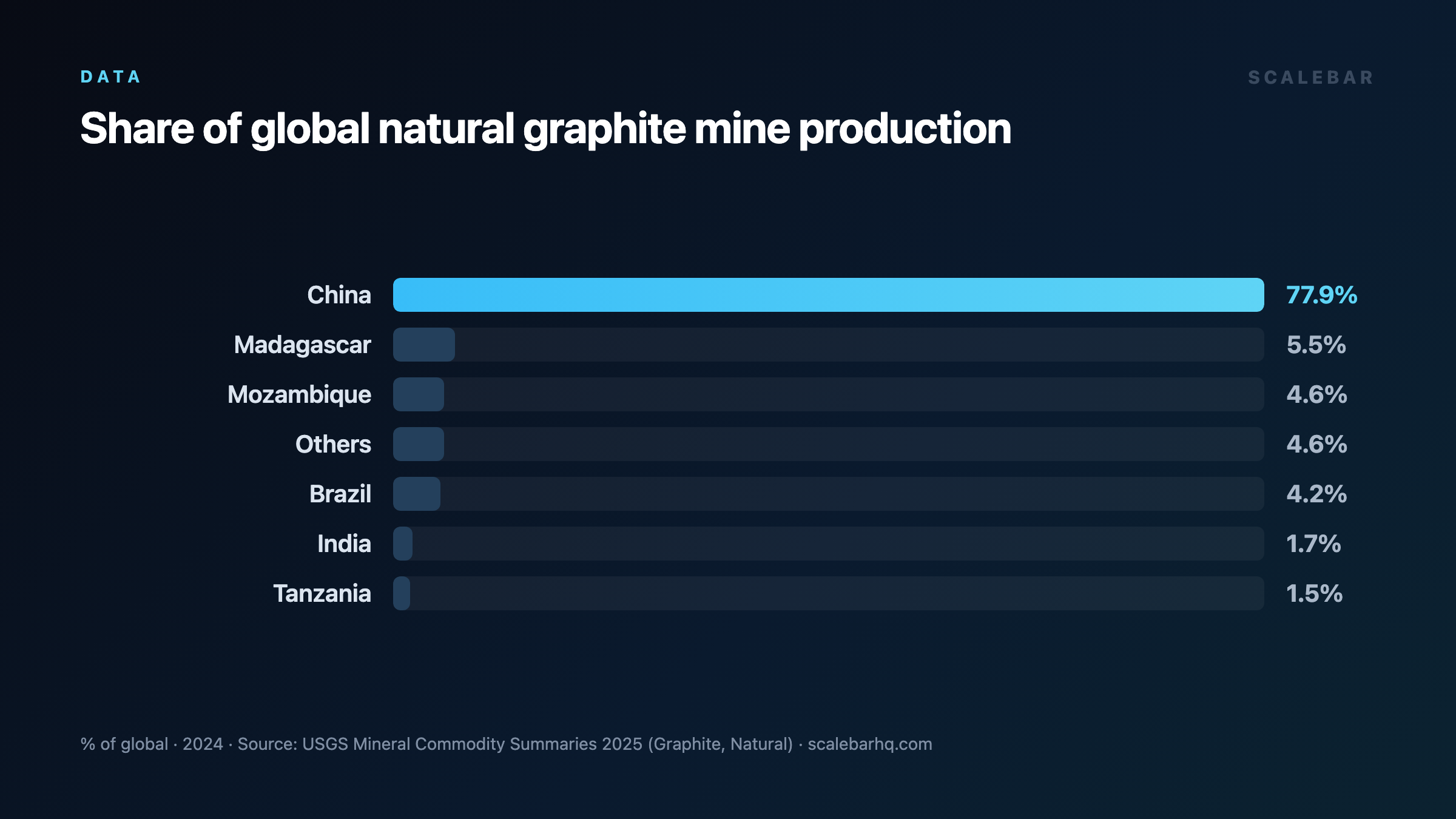
Of the 1.63 million metric tons mined globally each year, the vast majority originates from a single nation. China produces around 78% of the world's natural graphite, which translates to roughly 1.27 million metric tons per year.
This overwhelming market share gives China unprecedented influence over the global battery supply chain. No other country comes close to matching China's production capacity. This dominance is not merely a result of active mining operations; it is also backed by geological abundance. China holds the largest natural graphite reserves in the world, ensuring that its position as the primary global supplier is secure for the foreseeable future. For international manufacturers, this means that the road to battery production almost inevitably runs through Chinese supply chains.
Mozambique and the Balama Giant
While China is the undisputed leader, Mozambique has emerged as the clear number two in global natural graphite production. The East African nation produces close to 9% of the global natural graphite supply.
Mozambique's prominent position is largely anchored by a single asset: the Balama Mine. The Balama Mine is the single largest graphite mine on the planet, representing a massive concentration of production in one geographic location. The high output of this single mine, combined with China's massive domestic operations, means that China and Mozambique together account for about 80% of the global natural graphite supply.
This partnership—one a manufacturing and mining superpower, the other home to the world's largest single mining asset—creates a virtual duopoly in the natural graphite market. For global industries seeking to diversify their mineral sourcing, the options outside of these two nations are remarkably limited.
Alternative Producers and the Reserve Landscape
Outside of the top two producers, other nations contribute marginally to the global supply. Brazil is the most notable among them, producing about 6% of global natural graphite output. While Brazil represents an important alternative source of supply, its production capacity remains a fraction of China's.
In terms of reserves—the economically extractable graphite still in the ground—the distribution mirrors the production landscape but offers some potential for future diversification. China holds the largest reserves globally, but significant deposits are also located in Brazil, Mozambique, and Madagascar. However, turning underground reserves into active, high-yield mining operations requires years of capital investment, regulatory approval, and infrastructure development.
The Vulnerability of Importing Nations
The extreme concentration of natural graphite production poses a significant strategic challenge for Western nations, particularly the United States. Currently, the United States produces zero natural graphite domestically. It relies entirely on imports to satisfy its domestic demand.
For a country actively seeking to build domestic electric vehicle supply chains and reduce its reliance on foreign sources, this complete import dependence represents a severe vulnerability. Without domestic mining or highly diversified import options, American battery manufacturers remain entirely exposed to supply chain disruptions, export controls, or geopolitical tensions originating in the dominant producing nations.
As the global race for battery dominance intensifies, the concentration of natural graphite supply in just two countries highlights the fragility of the green energy transition. With 80% of the world's supply controlled by China and Mozambique, battery-hungry nations face a difficult path toward securing the raw materials necessary to power the future.
Frequently asked
- How much of a lithium-ion battery consists of natural graphite?
- Natural graphite makes up about 50% of a lithium-ion battery by weight, making it a critical component for electric vehicles, smartphones, and grid energy storage.
- Which countries dominate the global supply of natural graphite?
- China and Mozambique dominate the global supply, together accounting for about 80% of the world's natural graphite. China produces around 78% (roughly 1.27 million metric tons annually), while Mozambique produces close to 9%.
- What is the largest natural graphite mine in the world?
- The Balama Mine, located in Mozambique, is the single largest graphite mine on the planet.
- Does the United States produce any natural graphite?
- No, the United States produces zero natural graphite domestically and relies entirely on imports to meet its demand.
Sources
- https://its.ucdavis.edu/blog/releasing-pressure-cultivating-graphite-value-chains-expanding-market
- https://pubs.usgs.gov/periodicals/mcs2023/mcs2023-graphite.pdf
- https://pubs.usgs.gov/periodicals/mcs2024/mcs2024-graphite.pdf
- https://source.benchmarkminerals.com/article/infographic-china-controls-three-quarters-of-graphite-anode-supply-chain
- https://www.benchmarkminerals.com/glossary/what-is-graphite
- https://www.fortunebusinessinsights.com/natural-graphite-market-113565
- https://www.linkedin.com/posts/graphite-hub_natural-graphite-production-2025-more-concentrated-activity-7426724978143760384-qAB6
- https://www.lyellcollection.org/doi/10.1144/esss2024-014
- https://www.mining-technology.com/projects/balama-graphite-project
- https://www.statista.com/statistics/267367/reserves-of-graphite-by-country