Two Countries Control 80% of the World's Palladium
Russia and South Africa control the majority of global palladium supply, making their geopolitical stability crucial for automotive industries.
Two Countries Control 80% of the World's Palladium
Palladium is a critical metal used in catalytic converters to reduce harmful exhaust gases from vehicles. However, its global supply is almost entirely controlled by just two countries: Russia and South Africa.
The Dominance of Russia and South Africa
Russia is the largest producer of palladium, accounting for approximately 40% of the world's total production. This dominance is largely due to Nornickel, a major mining company based in Siberia. South Africa follows closely behind with roughly one-third of global supply, primarily from the Bushveld Complex, an extensive geological formation that holds about 54% of all known palladium resources.
Geological Significance
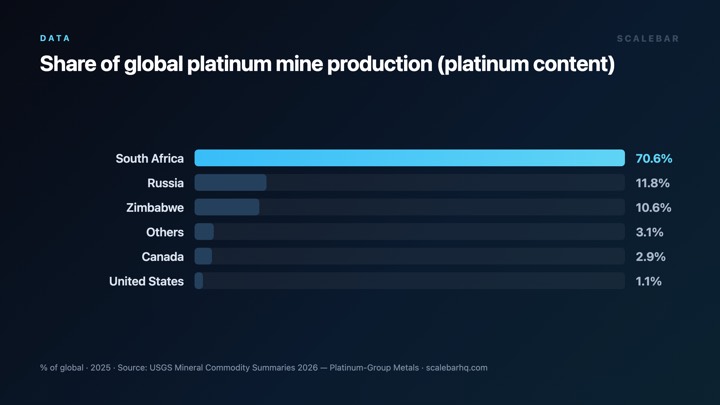
The Bushveld Complex is not just any ordinary rock formation; it's a geological marvel that has shaped the global palladium market. This complex in South Africa contains vast deposits of platinum group metals (PGMs), including palladium, making it an indispensable source for this critical metal.
Production Numbers
Global mine output of palladium stands at around 190 metric tons per year. While other countries like Canada and Zimbabwe do produce some palladium, their contributions are minimal compared to Russia and South Africa. For instance, South Africa produces about 71 tonnes annually, while Canada contributes only 16 tonnes.
Demand for Palladium
The demand for palladium is almost entirely driven by its use in catalytic converters. Approximately 85% of all palladium consumed globally goes into these devices to reduce toxic emissions from gasoline and hybrid vehicles. This high demand makes the supply chain highly sensitive to geopolitical events, as seen during Russia's invasion of Ukraine.
Market Impact
In March 2022, the market for palladium was shaken by geopolitical tensions. The price spiked to over $3,400 per troy ounce, making it more expensive than gold at that time. This sudden increase highlighted the critical nature of this metal and the potential risks associated with its supply chain.
Price Fluctuations
The price of palladium has fluctuated significantly in recent years. In 2021, it was approximately $3,000 per troy ounce, but by March 2022, it had surged to over $3,400. By 2023 and 2024, the price had fallen to around $1,493 and $1,000 per troy ounce, respectively.
Frequently Asked Questions
Q: Why is palladium so important for cars?
A: Palladium is crucial in catalytic converters because it helps reduce harmful exhaust gases from vehicles. Without this metal, emissions would be much more toxic.
Q: How does the Bushveld Complex contribute to global palladium supply?
A: The Bushveld Complex holds about 54% of all known palladium resources on Earth, making it a vital source for this critical metal. Its geological significance cannot be overstated in terms of its impact on the market.
Q: What are the geopolitical risks associated with palladium's supply chain?
A: Geopolitical events can significantly disrupt the supply chain of palladium. For example, Russia's invasion of Ukraine led to a spike in prices due to fears of potential supply disruptions.
Q: How does Nornickel contribute to Russia's dominance in palladium production?
A: Nornickel is the primary driver of Russia's palladium production. Its operations in Siberia are crucial for maintaining Russia's position as the world's largest producer of this metal.
Q: Can other countries increase their palladium output to reduce reliance on Russia and South Africa?
A: While Canada, Zimbabwe, and other countries do produce some palladium, their contributions are small compared to Russia and South Africa. Significant increases in production from these countries would be necessary to meaningfully impact the global market.
Conclusion
The near-duopoly of Russia and South Africa over the world's palladium supply highlights the critical role this metal plays in automotive emissions control. The geopolitical stability of these two countries is essential for maintaining a stable supply chain, which has significant implications for both environmental regulations and economic stability.
Frequently asked
- Why is palladium so important for cars?
- Palladium is crucial in catalytic converters because it helps reduce harmful exhaust gases from vehicles. Without this metal, emissions would be much more toxic.
- How does the Bushveld Complex contribute to global palladium supply?
- The Bushveld Complex holds about 54% of all known palladium resources on Earth, making it a vital source for this critical metal. Its geological significance cannot be overstated in terms of its impact on the market.
- What are the geopolitical risks associated with palladium's supply chain?
- Geopolitical events can significantly disrupt the supply chain of palladium. For example, Russia's invasion of Ukraine led to a spike in prices due to fears of potential supply disruptions.
- How does Nornickel contribute to Russia's dominance in palladium production?
- Nornickel is the primary driver of Russia's palladium production. Its operations in Siberia are crucial for maintaining Russia's position as the world's largest producer of this metal.
- Can other countries increase their palladium output to reduce reliance on Russia and South Africa?
- While Canada, Zimbabwe, and other countries do produce some palladium, their contributions are small compared to Russia and South Africa. Significant increases in production from these countries would be necessary to meaningfully impact the global market.
Sources
- https://ycharts.com/indicators/palladium_spot_price
- https://www.imarcgroup.com/palladium-pricing-report
- https://pubs.usgs.gov/periodicals/mcs2024/mcs2024-platinum-group.pdf
- https://www.chards.co.uk/guides/highest-palladium-price-history/755
- https://rmis.jrc.ec.europa.eu/uploads/jrc133117_briefing_palladium_final.pdf
- https://www.usgoldbureau.com/news/post/how-much-is-palladium-worth-today
- https://pubs.usgs.gov/periodicals/mcs2025/mcs2025-platinum-group.pdf
- https://www.ebsco.com/research-starters/science/south-africa-and-mining
- https://www.statista.com/statistics/273647/global-mine-production-of-palladium/
- https://www.monex.com/palladium-price-outlook-january-2024/
- https://ipa-news.com/index/sustainability/social/
- https://www.geologyforinvestors.com/geology-of-the-pge-deposits-in-the-bushveld-complex-south-africa/
- https://worldpopulationreview.com/country-rankings/palladium-production-by-country
- https://sprott.com/insights/platinum-and-palladium-are-on-the-move/
- https://www.chamines.co.zw/assets/uploads/2024/application/03f4054e-3587-462c-9274-ad9b93f2ff99.pdf
- https://www.phoenixrefining.com/blog/russia-s-role-in-the-palladium-market