The Country That Feeds the World's Bread Basket
How the concentration of wheat exports in Russia and Ukraine turns Black Sea geopolitical conflicts into global food security crises.
The Geopolitics of Wheat: How the Black Sea Shapes Global Food Security
Food security is fundamentally a question of geography. While agricultural production occurs worldwide, the global trade of staple crops is highly concentrated in a handful of key regions. Among these, the Black Sea basin stands as the most critical choke point for the global food supply. Together, Russia and Ukraine supply nearly a third of global wheat exports, making every geopolitical tremor in the region a direct food price shock for billions of people around the world.
When Russia invaded Ukraine in February 2022, the immediate consequence was not just a regional military conflict, but a global economic shockwave. Within weeks of the invasion, global wheat prices spiked by roughly 35 to 50 percent, depending on the specific variety. This sudden surge exposed the profound vulnerability of a globalized food system that relies heavily on a single, volatile geographic corridor.
The Giants of the Global Wheat Market
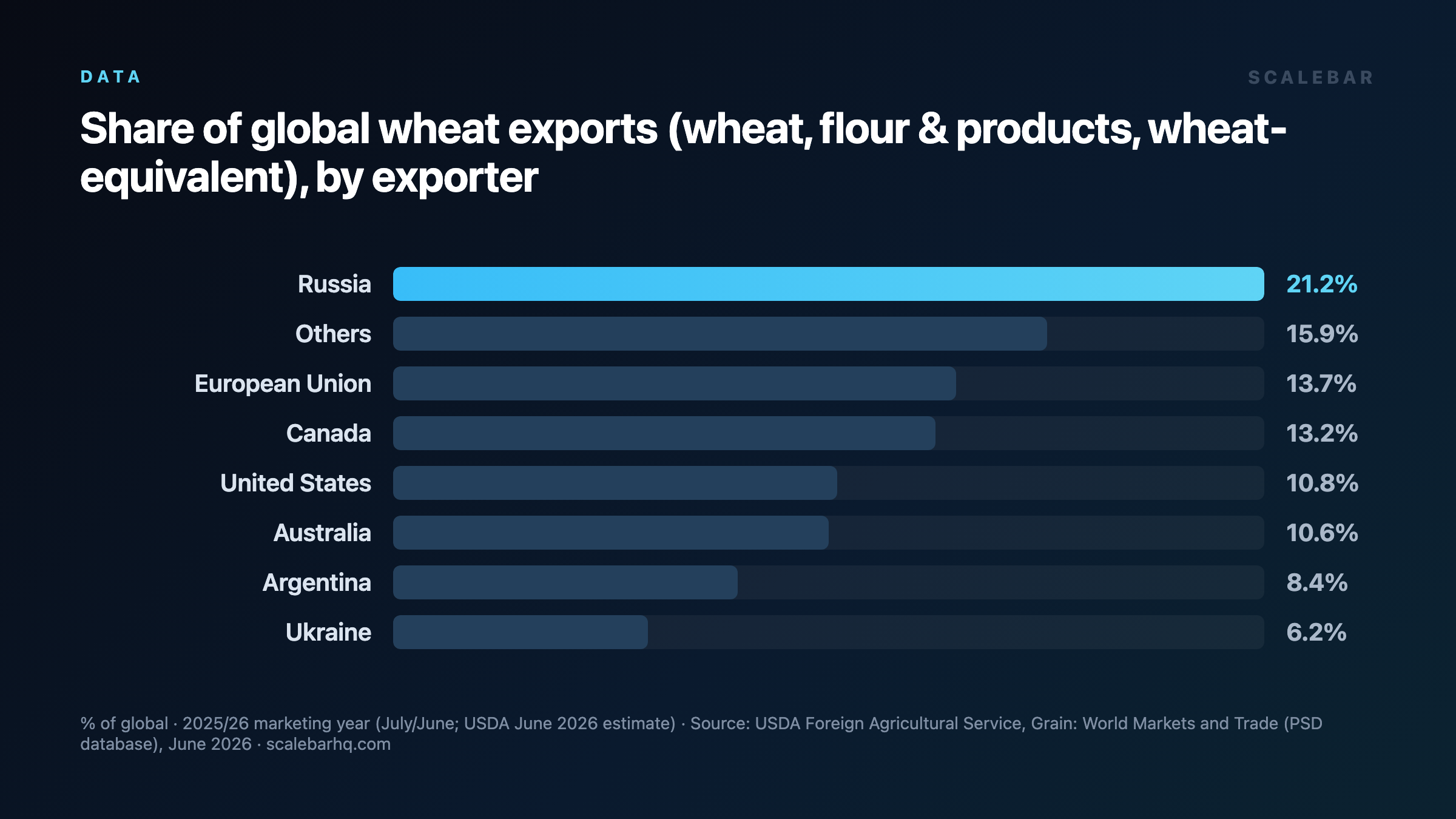
To understand why the Black Sea region wields such immense influence over global nutrition, one must look at the sheer volume of grain flowing from its ports. Russia is the world's leading wheat exporter, shipping approximately 45 million tonnes of wheat per year. Depending on the year and the specific data source, Russia alone accounts for between 13 and 26 percent of all wheat traded globally.
Before the onset of the war in 2022, Ukraine was also a towering force in agricultural markets, exporting between 16 and 20 million tonnes of wheat annually. Combined, Russia and Ukraine controlled between 25 and 29 percent—with some estimates placing the average at about 28 percent—of all global wheat exports.
To put these numbers into perspective, it is helpful to compare them to other major global agricultural producers:
- Australia exports around 26 million tonnes of wheat per year.
- The United States exports around 22 million tonnes of wheat per year.
- The European Union exports around 21 million tonnes of wheat per year.
While these nations are major agricultural powers, none individually match the scale of Russia's export capacity, and none of these regions face the same level of immediate geopolitical instability as the Black Sea.
The Rapid Expansion of Global Wheat Trade
The current fragility of the global food supply chain is a relatively modern phenomenon, driven by a rapid expansion in trade volume over the last two decades. In 2005, the global wheat trade volume stood at 107 million tonnes. By 2020, that figure had grown to 185 million tonnes, and by 2024, it reached approximately 198 million tonnes.
While this growing trade volume has helped feed a growing global population, the concentration of supply has outpaced this growth. Instead of diversifying, the global market became increasingly reliant on the highly productive, low-cost grain coming out of Russia and Ukraine. This concentration created a highly efficient but incredibly fragile system—one where a disruption in a single shipping lane could trigger a crisis thousands of miles away.
The Most Exposed Nations: Middle East and Africa
The impact of Black Sea instability is not felt equally across the globe. Lower-income nations, particularly in the Middle East and Africa, are disproportionately exposed to disruptions in this corridor. Countries like Egypt, Turkey, and Bangladesh source more than half of their total wheat imports directly from the Black Sea region.
Egypt, the world's largest wheat importer, serves as a stark case study in geographic dependency. Historically, Egypt has relied on Russia and Ukraine combined for roughly 80 percent of its wheat imports, with Russia acting as the dominant supplier. In 2022, Egypt sourced roughly 25 percent of its wheat from Ukraine alone. To manage this extreme dependency and mitigate the risks of the war, Egypt has had to look elsewhere, sourcing about 12 percent of its wheat imports from Romania, among other alternative suppliers.
For these nations, wheat is not just a commodity; it is a dietary staple that underpins social stability. When prices spike by 35 to 50 percent in a matter of weeks, governments face severe fiscal strain trying to subsidize bread, and millions of citizens face immediate food insecurity.
War, Shifting Corridors, and Market Adaptation
The 2022 invasion fundamentally altered the flow of Black Sea grain, though it did not stop it entirely. Ukraine's agricultural infrastructure and shipping ports faced immediate blockades and bombardment. As a result, Ukraine's wheat exports fell by close to 50 percent since the 2022 invasion. Despite this massive blow, Ukraine has remained active in the market, continuing to ship wheat (currently around 16 million tonnes per year) through alternative corridors and overland routes.
Conversely, Russia has managed to increase its dominance. By offering discounted prices, Russia has locked in buyers across Asia and Africa, leveraging its massive 45-million-tonne export capacity to expand its geopolitical and economic influence.
The lesson of the ongoing Black Sea crisis is clear. When a handful of nations dominate a staple crop that dozens of lower-income countries depend on for a massive portion of their food supply, geography becomes destiny. In the modern global economy, food security is no longer just an agricultural challenge—it is a matter of high-stakes geopolitics.
Frequently asked
- What percentage of global wheat exports do Russia and Ukraine control?
- Together, Russia and Ukraine control between 25% and 29% of all global wheat exports, with some estimates placing their combined share at approximately 28%.
- How much wheat do Russia and Ukraine export individually?
- Russia exports around 45 million tonnes of wheat per year, making up between 13% and 26% of the global trade. Before the 2022 invasion, Ukraine exported between 16 and 20 million tonnes per year. Since the invasion, Ukraine's wheat exports have fallen by close to 50%, though it still exports around 16 million tonnes per year.
- Which countries are most vulnerable to disruptions in Black Sea wheat exports?
- Egypt, Turkey, and Bangladesh are highly vulnerable, as they source more than half of their wheat imports from the Black Sea region. Egypt is particularly dependent, historically sourcing roughly 80% of its wheat imports from Russia and Ukraine combined.
- How has the global wheat trade grown over time?
- The global wheat trade has expanded significantly over the last two decades. The total volume rose from 107 million tonnes in 2005 to 185 million tonnes in 2020, and reached approximately 198 million tonnes in 2024.
- How do other major global wheat exporters compare to Russia?
- While Russia exports around 45 million tonnes of wheat per year, other major global exporters ship lower volumes. Australia exports around 26 million tonnes, the United States exports around 22 million tonnes, and the European Union exports around 21 million tonnes annually.
Sources
- https://www.aljazeera.com/news/2022/2/17/infographic-russia-ukraine-and-the-global-wheat-supply-interactive
- https://farmonaut.com/australia/australia-wheat-boom-record-32m-tonnes-forecast-2024-25
- https://english.news.cn/20250705/24b148bd184743a5b6f37d5f43dc9ec9/c.html
- https://www.facebook.com/bloombergbusiness/posts/the-most-populous-arab-nation-imports-the-majority-of-its-wheat-from-russia-and-/389487316370701
- https://www.facebook.com/marketwatch/posts/usda-raises-20232024-crop-year-wheat-export-forecasts-for-russia-and-ukraine/693558075977850
- https://www.statista.com/statistics/1309988/share-of-wheat-imports-by-country-to-egypt
- https://www.magyp.gob.ar/new/0-0/programas/dma/usda/grains/2008/2008-10-15.pdf
- https://www.reuters.com/markets/europe/ukraine-crisis-jeopardises-middle-easts-black-sea-wheat-supply-2022-03-07
- https://www.sciencedirect.com/science/article/pii/S2405851324000412
- https://www.eurasian-research.org/publication/analysis-of-the-global-wheat-market
- https://www.feedandadditive.com/global-grain-supply-and-demand-set-to-break-records-in-new-season
- https://www.facebook.com/i24NEWSEN/posts/ukraines-key-food-exports-fell-by-almost-half-since-russian-invasion-the-2022-gr/2207293112772679
- https://www.facebook.com/FortuneMagazine/posts/russia-and-ukraine-are-both-major-global-exporters-of-wheat-and-its-unclear-how-/10159438274192949
- https://www.facebook.com/uacrisis/posts/despite-the-losses-from-the-war-ukraine-became-the-ninth-largest-producer-of-whe/5740543556014352
- https://www.fas.usda.gov/data/russia-grain-and-oilseed-exports-expand
- https://cgspace.cgiar.org/bitstreams/e79e37f4-5240-4dbc-b852-81b9890c3086/download
- https://cropgpt.ai/ukraine-wheat-2023-2024-export-volumes-exceed-16-million-tonnes
- https://esmis.nal.usda.gov/sites/default/release-files/cz30ps64c/nk324844t/qr46sv01w/WHS-24l.pdf
- https://apps.fas.usda.gov/newgainapi/api/Report/DownloadReportByFileName?fileName=Decline+in+Ukraine+Wheat+Imports+Drives+Egypt+to+Diversify+its+Suppliers+_Cairo_Egypt_EG2022-0015.pdf