Portugal Controls Half the World's Cork Supply
How a slow-growing tree and a 25-year harvest cycle secured Portugal's billion-euro agricultural monopoly.
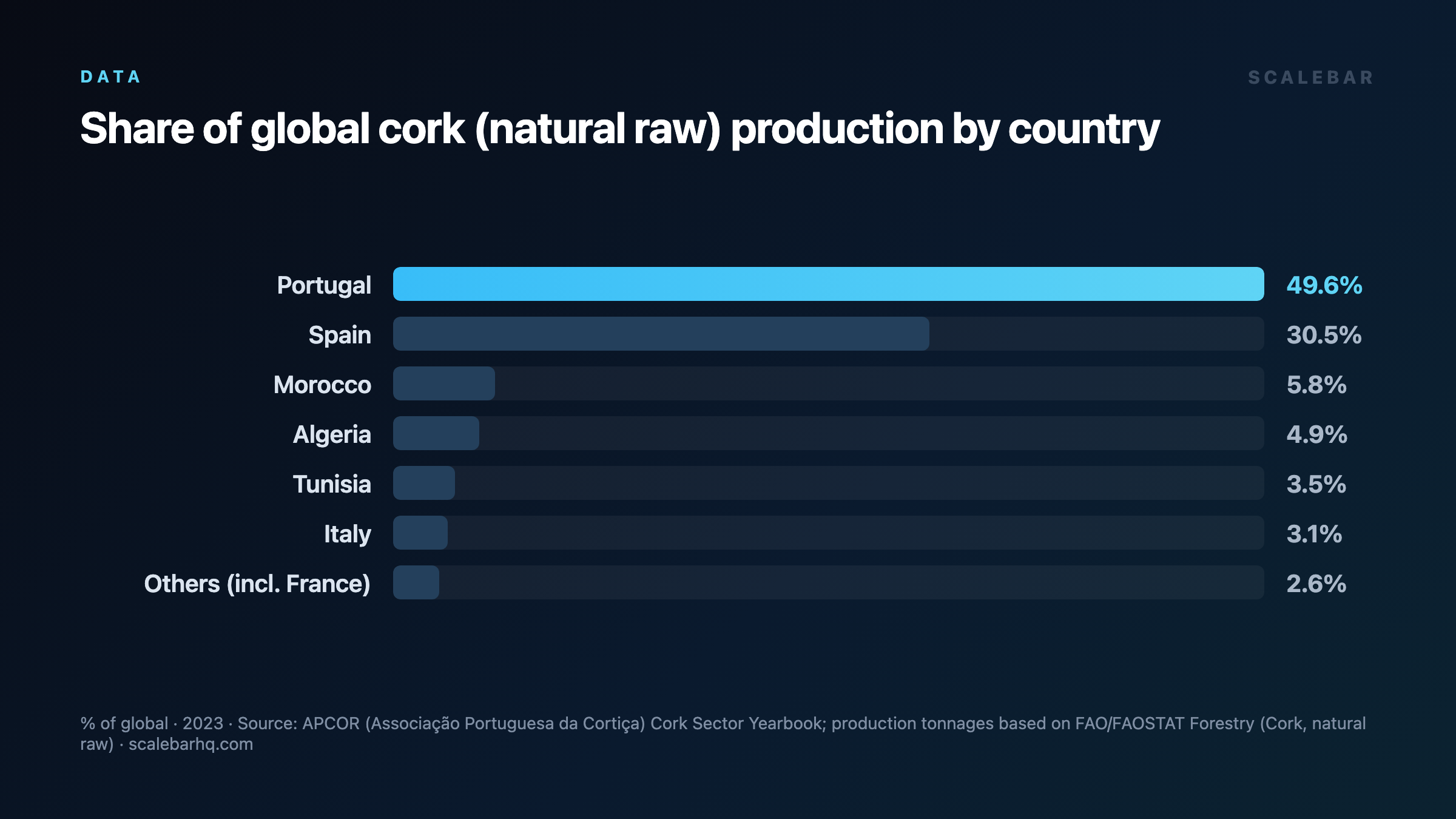
Every year, the global wine and bottling industries demand an astronomical number of closures to seal their products. Specifically, the world uses over 13 billion cork stoppers every year. This massive demand feeds into a highly centralized supply chain. Instead of being distributed evenly across various agricultural hubs, the production of this essential material is concentrated in a single geographic region. Portugal, a relatively small nation on the Iberian Peninsula, produces nearly 50% of the world's entire cork supply.
This near-monopoly gives the country outsized control over a global industry worth over a billion euros. No other country comes close to matching this output, establishing Portugal as the undisputed heavyweight of the global cork trade.
The Geography of the Cork Forest
Portugal's dominance is not merely a result of modern industrial strategy; it is deeply rooted in the physical geography of the land. The country holds about one third of all cork oak forest on the planet. This translates to an expansive 730,000 hectares of cork oak forest dedicated to this single species.
To put this in perspective within Portugal's own borders, cork oak covers a massive portion of the country's wooded areas, accounting for roughly 23% to 28% of Portugal's entire national forest. This makes the cork oak not just a commercial crop, but a defining ecological and visual feature of the Portuguese landscape.
While other Mediterranean nations share similar climates, none have cultivated or preserved this resource to the same extent. Spain, Portugal's neighbor on the Iberian Peninsula, is the second-largest producer, yet it produces 20% of global cork—less than half of Portugal's output. Together, these two nations control the vast majority of the market, but Portugal remains the clear leader.
The Biology of Barriers to Entry
Why can't other countries simply plant cork oak forests and compete with Portugal? The answer lies in the extraordinary, slow-yielding biology of the cork oak tree. Unlike typical agricultural crops that offer annual yields, or even standard timber forestry that harvests on a decadal scale, cork production requires immense patience.
- The First Harvest: A cork oak tree takes about 25 years from planting to its very first harvest. This initial bark is often of lower quality and is not yet suitable for high-grade wine stoppers.
- The Regeneration Cycle: Once the tree is established and has undergone its first harvest, the bark cannot be stripped continuously. Instead, the bark is stripped by hand only once every 9 years.
This manual stripping process requires highly skilled labor to ensure the tree's living inner bark is not damaged, allowing the protective outer layer to slowly regenerate over nearly a decade.
This slow, multi-decade cycle creates an almost insurmountable barrier to entry for potential competitors. Any country or region wishing to challenge Portugal's dominance would have to invest massive capital and wait a quarter of a century just to see their first harvest, followed by decades of nine-year cycles to achieve mature, high-quality yields. Consequently, Portugal's monopoly is protected not just by trade agreements or technology, but by the slow, unyielding laws of nature.
A Billion-Euro Economic Engine
This slow-motion agricultural process translates into a highly lucrative modern industry. Portugal's cork sector generates over 1.2 billion euros every single year. This revenue is not merely a minor contributor to the national economy; it represents a major export engine and a source of stable, long-term economic security.
Because the world uses over 13 billion cork stoppers every year, the demand for high-quality closures remains robust. While synthetic stoppers and screw caps exist, natural cork remains highly valued, ensuring that Portugal's 730,000 hectares of forest remain a highly lucrative asset. The 1.2 billion euros generated annually flows through a sophisticated supply chain that includes forest management, skilled harvesting, processing facilities, and global distribution networks. By controlling close to 50% of the global supply, Portuguese firms hold significant pricing power and influence over the global packaging and wine industries.
In an era of rapid industrialization and fast-moving supply chains, the cork industry stands as a remarkable exception. It is an industry where patience is the ultimate competitive advantage. Portugal's strategic stewardship of its cork oak forests has secured its position at the center of a global trade network. Through a combination of geographic fortune, biological barriers, and centuries of forestry tradition, Portugal's outsized control over the global cork supply remains secure for generations to come.
Frequently asked
- How much of the world's cork supply does Portugal produce?
- Portugal produces nearly 50% of the world's entire cork supply.
- How long does it take to harvest cork from a cork oak tree?
- A cork oak tree takes about 25 years to reach its first harvest. After that, the bark is stripped by hand every 9 years.
- How much forest land in Portugal is dedicated to cork oak?
- Portugal has 730,000 hectares of cork oak forest, which represents about one third of all cork oak forest on the planet and covers roughly 23% to 28% of Portugal's national forest.
- What is the annual economic value of Portugal's cork industry?
- Portugal's cork sector generates over 1.2 billion euros every year.
- Which country is the second-largest producer of cork?
- Spain is the second-largest producer, accounting for 20% of global cork production.
Sources
- https://arboretum.ucdavis.edu/news/uc-davis-cork-harvest
- https://wifitalents.com/portugal-cork-industry-statistics
- https://geckoyogamats.com/blogs/gecko-journal/portuguese-cork-industry
- https://www.facebook.com/Portugal.Architecture/posts/cork-tree-forest-the-cork-oak-sobreiro-quercus-suber-is-the-national-tree-of-por/1399654682193440
- https://www.frontiersin.org/journals/forests-and-global-change/articles/10.3389/ffgc.2024.1332708/full
- https://www.facebook.com/herdadedosgrous/posts/the-cork-oak-is-a-wonderful-tree-it-lives-in-an-ecosystem-with-a-delicate-balanc/3713383582025977
- https://www.facebook.com/wineecon/posts/leading-exporters-of-cork-stoppers-2024-with-portugal-accounting-for-over-76-of-/1026438199739291
- https://www.facebook.com/businessinsiderssa/posts/nearly-half-of-the-worlds-cork-wine-stoppers-come-from-portugal-cork-agriculture/896095259644086
- https://www.climatechangepost.com/news/managing-cork-oak-production-under-climate-change-in-portugal
- https://jelinek.com/blog/cork-harvest-process
- https://wifitalents.com/portugal-cork-industry-statistics/, https://www.reddit.com/r/todayilearned/comments/1mqovkl/til_that_portugals_cork_industry_became_a_billio/, https://www.forbes.com/sites/danielscheffler/2025/12/03/how-portugals-cork-forests-became-a-billion-dollar-eco-marvel/, https://www.fao.org/4/x5362e/x5362e03.htm, https://naturalcorkcouncil.org/reports-and-statistics
- https://wifitalents.com/portugal-cork-industry-statistics/
- https://gitnux.org/cork-industry-statistics
- https://www.lafittecork.com/us/news/cork-harvesting-process
- https://www.forbes.com/sites/danielscheffler/2025/12/03/how-portugals-cork-forests-became-a-billion-dollar-eco-marvel/
- https://corkeen.com/en/why-cork/facts-and-curiosities/about-oak-forest
- https://www.facebook.com/groups/zonepushers/posts/10161459945010727
- https://www.precisionreports.co/market-reports/cork-stoppers-market-605626
- unclear
- https://www.naturalcorkcouncil.org/
- https://www.facebook.com/businessinsider/videos/the-portuguese-cork-industry-reached-an-all-time-sales-high-of-13-billion-in-2023/1201882354479421/