OPEC Still Controls More Oil Than You Think
Despite the rise of North American shale, the 12-nation cartel and its allies still hold the ultimate keys to global energy markets.
The global energy landscape has undergone dramatic shifts over the past two decades. The rise of hydraulic fracturing and horizontal drilling in North America led many analysts to declare the end of traditional energy cartels. With the United States surging to become a leading crude producer, the narrative of Western energy independence grew popular. However, this perspective overlooks a fundamental geological reality. The Organization of the Petroleum Exporting Countries (OPEC), a group of 12 member countries, continues to hold the ultimate keys to the global energy market. While daily production headlines often focus on non-OPEC growth, OPEC nations hold the majority of the world's proven oil reserves and remain the single biggest lever on global oil prices.
The Geological Foundation: Proven Reserves
To understand the true balance of power in global energy, one must look beneath the surface. Daily production is a measure of current industrial activity, but proven reserves represent long-term geopolitical and economic endurance. OPEC's 12 member countries collectively hold an astonishing 80% of the world's proven oil reserves.
This concentration of underground wealth ensures that whatever short-term fluctuations occur in global markets, the long-term trajectory of oil supply remains anchored in OPEC territories. While non-OPEC nations must constantly invest heavily in complex, expensive extraction methods to maintain their output, OPEC members sit on vast, easily accessible reservoirs that can sustain production for decades to come.
Daily Production and the Core Members
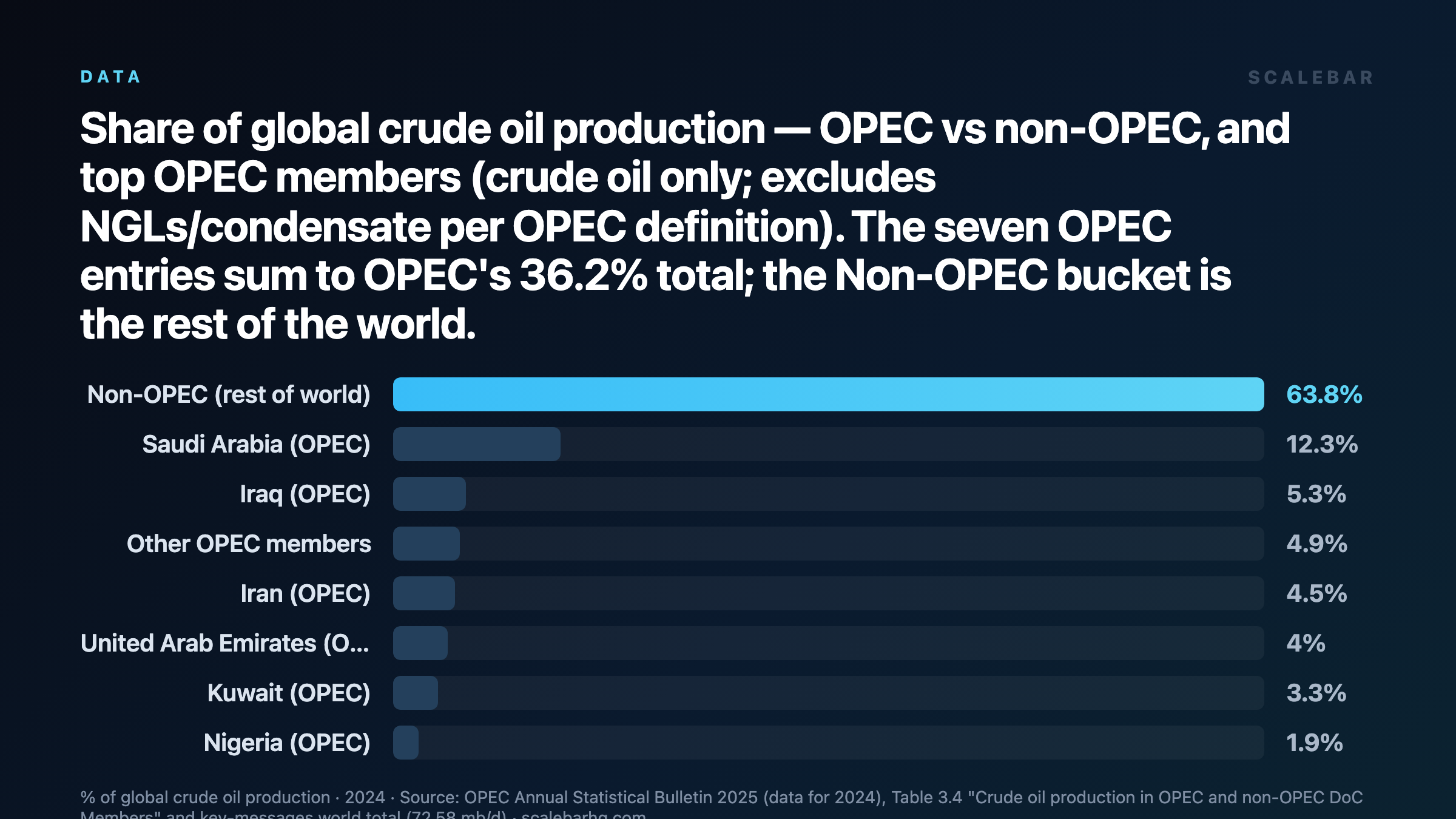
Despite holding four-fifths of the world's underground oil, OPEC manages its daily output strategically to maintain market stability and price levels. Currently, OPEC pumps roughly 30% of all oil produced daily worldwide.
Within the cartel, production is led by a handful of heavyweights:
- Saudi Arabia is the undisputed leader of the group, producing around 8.98 million barrels per day.
- Iraq produces around 4.5 million barrels per day (with some industry assessments placing daily production at 4.3 million barrels per day).
- The United Arab Emirates (UAE) produces around 2.95 million barrels per day.
- Kuwait produces around 2.42 million barrels per day.
Together, these nations form the core of the cartel's daily market presence, coordinating their output to balance global supply and demand.
The Strategic Weapon: Spare Capacity
While daily production figures are impressive, OPEC's most potent economic tool is not what it actively pumps, but what it keeps in reserve. This is known as spare capacity—the volume of production that can be brought online quickly to mitigate supply disruptions or shut down to prevent a market glut.
Saudi Arabia alone holds a spare capacity of 3 million barrels per day, which is switchable within weeks. No other country or private oil enterprise in the world possesses this level of rapid flexibility. In the event of geopolitical conflict, natural disasters, or sudden demand spikes, Saudi Arabia can adjust this 3 million barrel-per-day lever to stabilize or disrupt the global economy. This unique capability functions similarly to a central bank's control over interest rates, giving the kingdom unparalleled influence over global energy security.
The Non-OPEC Counterweight
The primary challenge to OPEC's dominance in recent years has come from North America. The United States has experienced an unprecedented production boom, with the USA now producing over 13 million barrels of oil per day (with peak figures exceeding 13.2 million barrels per day). This makes the US the single largest producer of crude oil in the world, surpassing any individual OPEC member. Additionally, Canada has emerged as a major global supplier, producing around 4.9 million barrels per day.
This surge in North American production has provided a vital buffer for global consumers, reducing direct dependence on Middle Eastern crude. However, unlike OPEC's state-run oil companies, North American production is driven by private corporations responsive to immediate shareholder returns and market prices, meaning they cannot easily coordinate production cuts or maintain massive idle spare capacity for geopolitical purposes.
The OPEC+ Alliance
Recognizing that the rise of North American shale threatened its unilateral pricing power, OPEC expanded its reach. By partnering with several non-OPEC producers, most notably Russia, the group formed a broader coalition known as OPEC+.
Russia itself is a massive energy player, producing around 10.5 million barrels per day. By aligning their market strategies, OPEC+ controls about 50% of global oil supply. This expanded alliance effectively counters the rise of US shale. When OPEC+ decides to restrict supply, the sheer volume of their combined output—representing half of the world's daily oil—gives them enormous pricing power. A coordinated reduction of even a fraction of this supply can trigger immediate upward pressure on global crude prices, demonstrating that the cartel's influence is far from obsolete.
The Reality of Market Leverage
The geography of oil is unyielding. While technological innovations have allowed countries like the United States and Canada to reach historic production levels, the underlying geology favors the 12 nations of OPEC. Holding 80% of the world's proven reserves and controlling half of the global supply through the OPEC+ alliance, these nations remain the primary arbiters of global energy costs. As long as the global economy relies on liquid petroleum, the levers controlled by OPEC and its partners will continue to shape international economics and geopolitics.
Frequently asked
- What percentage of the world's proven oil reserves does OPEC hold?
- OPEC member countries hold 80% of the world's proven oil reserves, giving them long-term dominance over global oil supplies.
- How much oil does the United States produce compared to OPEC members?
- The United States produces over 13 million barrels of oil per day (with specific figures exceeding 13.2 million barrels per day). This makes the US the single largest individual producer in the world, producing more than any single OPEC member country.
- What is OPEC+ and how much of the global oil supply does it control?
- OPEC+ is an alliance between the 12 OPEC member countries and other major non-OPEC producers, including Russia (which produces around 10.5 million barrels per day). Together, the OPEC+ coalition controls about 50% of the global oil supply.
- What is spare capacity, and why does Saudi Arabia's matter?
- Spare capacity is the volume of oil production that can be brought online quickly to respond to market changes. Saudi Arabia has a spare capacity of 3 million barrels per day that is switchable within weeks, allowing it to act as a stabilizer or disruptor in the global market.
Sources
- https://www.rigzone.com/news/usa_hits_new_crude_oil_production_record-04-sep-2025-181691-article
- https://x.com/OPECSecretariat/status/2026627032193314902?lang=en
- https://economics.td.com/ca-oil-production-2024
- https://www.reuters.com/business/energy/russian-oil-output-expected-hold-steady-2024-2023-12-27
- https://mei.edu/backgrounder/opec-and-opec/
- https://www.worldometers.info/oil/iraq-oil/
- https://www.aa.com.tr/en/energy/oil/opecs-share-of-global-crude-output-ticks-higher-in-2025/56696
- https://fred.stlouisfed.org/series/SAUNGDPMOMBD
- https://www.focus-economics.com/country-indicator/uae/oil-prod
- https://www.worldometers.info/oil/iraq-oil
- https://www.eia.gov/dnav/pet/hist/leafhandler.ashx?n=pet&s=mcrfpus2&f=m
- https://www.forbes.com/sites/rrapier/2024/12/22/us-energy-dominance-continues-another-annual-oil-production-record
- https://www.iea.org/reports/oil-market-report-december-2024
- https://www.investopedia.com/terms/o/oil-reserves.asp
- https://www.edwardconard.com/macro-roundup/the-us-set-a-new-crude-production-record-in-august-of-13-4mm-bpd-eiagov-predicts-daily-production-will-rise-to-13-5mm-bpd-in-2025-the-us-has-been-the-worlds-top-oil-producer-since-2018
- https://www.focus-economics.com/country-indicator/kuwait/oil-prod
- https://www.reuters.com/business/energy/factbox-opec-saudi-spare-oil-production-capacity-2024-01-30
- https://www.reuters.com/markets/commodities/russias-oil-output-down-28-gas-production-up-76-2024-deputy-pm-says-2025-01-30
- https://www.linkedin.com/posts/commodity-trading-club_who-produces-the-most-oil-in-the-world-activity-7354144108258430977-Pf8D
- https://oilprice.com/Energy/Energy-General/Saudi-Aramcos-Spare-Oil-Production-Capacity-Is-Now-3-Million-Bpd.html
- https://www.opec.org/member-countries.html