One Country Produces Most of the World's Vanilla
A single island nation controls the majority of the world's natural vanilla supply, leaving global markets vulnerable to extreme price shocks and climate disruptions.
Vanilla is the most widely used flavor on the planet. From the food industry to cosmetics and fine perfumes, its distinct aromatic profile is a staple of global consumer goods. Yet, behind this ubiquitous flavor lies an incredibly concentrated and fragile agricultural network. Roughly 60 percent of the global vanilla supply originates from a single country: Madagascar.
This extreme geographic concentration creates a single point of failure for global industries, making vanilla one of the most fragile single-origin supply chains on Earth. When environmental or economic disruptions strike this island nation, the shockwaves are felt by manufacturers and consumers worldwide.
The Global Landscape of Vanilla Production
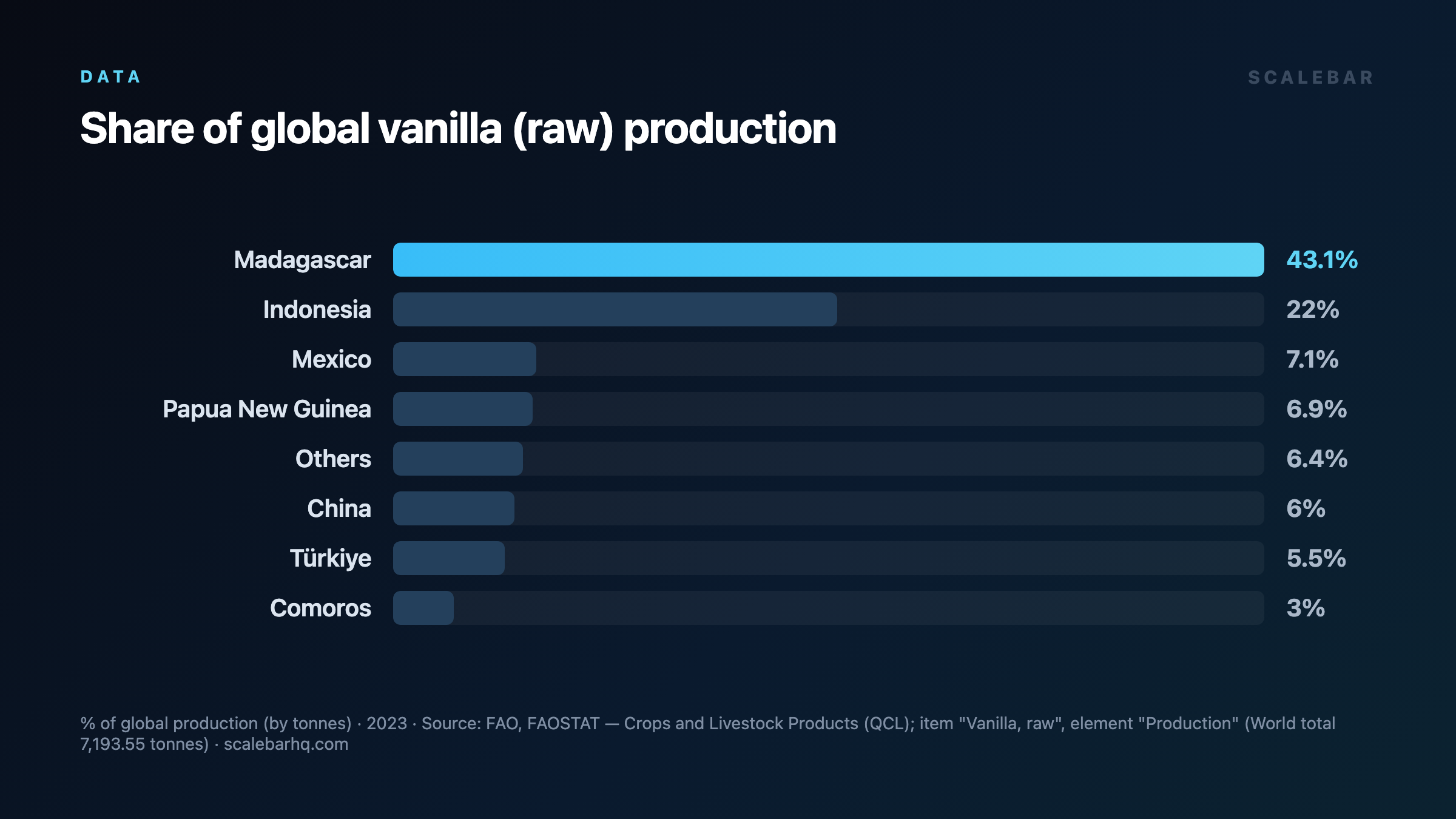
The global production of natural vanilla is highly concentrated in just a few tropical regions. While Madagascar sits at the undisputed center of this market, producing roughly 60 percent of the world's supply, other nations play supporting roles.
Indonesia represents the second-largest producer, accounting for nearly 29 percent of the world's vanilla supply. Papua New Guinea contributes around 10 percent of the global supply.
This distribution leaves the global market highly dependent on the agricultural output of a very small number of developing nations. Because vanilla requires specific tropical climates to grow, production cannot easily be relocated to other parts of the world. Consequently, any localized disruption in Madagascar—whether due to political instability, economic shifts, or severe weather—immediately threatens the majority of the global supply, leaving buyers with very few alternative sources.
The Labor-Intensive Reality of Vanilla Cultivation
The vulnerability of the vanilla supply chain is compounded by the extraordinary difficulty of cultivating the crop. Unlike many other global commodities that have been highly mechanized, vanilla production remains almost entirely manual.
In Madagascar, nearly 100 percent of vanilla is pollinated manually by hand. This intensive manual labor is a biological necessity. The natural pollinator of the vanilla orchid is a specific Mexican bee, which does not exist in Madagascar. Without this native insect, the orchids cannot reproduce naturally on the island.
To produce a vanilla bean, agricultural workers must individually pollinate each flower by hand during a very brief blooming window. This meticulous process requires immense skill, patience, and a massive labor force. The reliance on manual pollination means that production capacity is strictly limited by human labor, making the supply highly inelastic and sensitive to local labor conditions.
A History of Extreme Price Volatility
Because the global supply is concentrated in Madagascar and production is so labor-intensive, vanilla prices are notoriously volatile. The market has experienced dramatic price swings over the past decade, illustrating the inherent instability of a single-origin supply chain.
Before 2015, vanilla prices were relatively stable and low, sitting below 40 dollars per kilogram. However, as demand grew and supply remained tight, prices began to climb, reaching 100 USD per kg in 2015.
The fragility of the system was fully exposed in 2017. A powerful cyclone struck Madagascar, devastating plantations and severely disrupting the harvest. Because there was no alternative producer capable of making up for Madagascar's roughly 60 percent market share, the sudden supply shortage caused prices to spike to an unprecedented 600 USD per kg in 2017.
In the years following the cyclone, the market slowly adjusted, but prices remained elevated and highly unstable. By 2019, the price of vanilla had eased slightly but remained high at 450 USD per kg. By 2022, as production began to recover and global markets stabilized, the price fell further to 250 USD per kg. These dramatic fluctuations demonstrate how a single weather event in one geographic region can trigger massive, multi-year economic consequences for global industries.
The Synthetic Alternative and Market Dynamics
To mitigate the risks and high costs associated with natural vanilla, the food and fragrance industries have long relied on a chemical workaround: synthetic vanillin. Synthetic vanillin is made mostly from petrochemicals or wood pulp, offering a highly consistent and easily scalable alternative to agricultural vanilla.
The economic contrast between natural vanilla and its synthetic counterpart is stark. While natural vanilla prices have fluctuated between hundreds of dollars per kilogram, synthetic vanillin costs approximately 15 USD per kg. This massive price differential makes synthetic vanillin the dominant choice for mass-market products, where cost efficiency is paramount.
Despite the availability of cheap synthetic alternatives, natural vanilla remains highly prized. High-end food manufacturers, cosmetic brands, and premium fragrance houses continue to demand natural vanilla for its complex flavor profile. This persistent demand ensures that natural vanilla commands a significant premium, keeping the global market tethered to Madagascar's agricultural output despite the financial risks.
The Economic Paradox of Madagascar
The global demand for natural vanilla creates a profound economic paradox. Madagascar produces roughly 60 percent of the world's supply of one of the most expensive and sought-after agricultural commodities on Earth. Yet, despite this valuable near-monopoly, Madagascar remains one of the poorest countries on Earth.
The wealth generated by the high prices of vanilla rarely translates into long-term economic security for the local farmers who perform the grueling work of manual pollination. Because the supply chain is highly volatile and vulnerable to climate shocks, local communities face extreme economic instability. A single storm can wipe out a family's livelihood, while price crashes can leave farmers unable to cover their production costs. This economic vulnerability reinforces the cycle of poverty, leaving the country highly dependent on a single, fragile crop.
Conclusion
The global vanilla market serves as a stark case study in supply chain vulnerability. By relying on Madagascar for roughly 60 percent of its natural vanilla, the global economy has created a system where a single localized event—such as a cyclone or a shift in local labor dynamics—can disrupt industries worldwide. As climate change increases the frequency and severity of extreme weather events, the fragility of this single-origin supply chain will likely continue to challenge producers and consumers alike, highlighting the delicate balance between global demand and geographic reality.
Frequently asked
- What percentage of the world's vanilla supply comes from Madagascar?
- Madagascar produces roughly 60 percent of the global vanilla supply.
- Why must vanilla in Madagascar be pollinated by hand?
- Nearly 100 percent of Madagascar's vanilla is pollinated manually by hand because its natural pollinator, a specific Mexican bee, does not exist in Madagascar.
- How high did vanilla prices rise during the 2017 price spike?
- Following a cyclone in 2017, vanilla prices surged past 600 USD per kilogram.
- What is synthetic vanillin made from, and how much does it cost?
- Synthetic vanillin is made mostly from petrochemicals or wood pulp and costs approximately 15 USD per kilogram.
Sources
- https://www.fao.org/one-country-one-priority-product/asia-pacific/papua-new-guinea/en
- https://www.skyminder.com/blog/analysis-studies/vanilla-a-look-at-madagascars-trade
- https://www.fairtrade.net/content/dam/fairtrade/fairtrade-international/library/2024/living-income-reference-prices-for-vanilla-from-uganda-and-madagascar/Fairtrade-Vanilla-Living-Income-Ref-Price-Madagascar-report-2024.pdf
- https://www.foodbusinessnews.net/articles/13570-vanilla-prices-slowly-drop-as-crop-quality-improves
- https://weather.com/news/news/vanilla-prices-cyclone-enawo-madagascar
- https://www.nyvanilla.com/blogs/updates/vanilla-price-fluctuations-market-volatility-factors
- https://www.mordorintelligence.com/industry-reports/global-vanilla-industry
- https://www.choicesmagazine.org/UserFiles/file/cmsarticle_997.pdf
- https://www.choicesmagazine.org/choices-magazine/submitted-articles/sourcing-vanilla-closer-to-home-market-potential-for-us-production
- https://www.lebonmagot.com/blogs/stories/hand-pollinating-orchids
- https://www.researchgate.net/figure/Average-Price-for-Vanilla-from-1971-to-2017-per-kilogram-Wexler-2017_fig1_337895657
- https://www.mordorintelligence.com/industry-reports/vanillin-market
- https://monchynaturalmassey.com/wp-content/uploads/2017/11/2023-nmw-vanilla-crop-report.pdf
- https://en.wikipedia.org/wiki/Edmond_Albius
- https://cen.acs.org/synthesis/process-chemistry/greener-path-toward-vanillin-paper/98/i19
- https://www.tridge.com/market-overview/vanilla-bean
- https://www.foodunfolded.com/article/vanilla-beans-the-cost-of-production
- https://prezi.com/p/b9_yh_y7gamo/identifying-and-prioritizing-strategic-factors-to-improve-indonesias-vanilla-export-performance-in-the-german-market
- https://cooksvanilla.com/blogs/news/vanilla-market-report-march-2018
- https://www.facebook.com/groups/1178576906113839/posts/1893564817948374
- https://www.symrise.com/our-stories/150-shades-of-innovation/vanilla/eight-facts
- https://www.facebook.com/groups/flyriverforum/posts/1460625684038981
- https://cooksvanilla.com/blogs/news/vanilla-market-report-november-2017
- https://www.eater.com/2017/10/19/16468074/vanilla-prices-rising
- https://www.researchgate.net/publication/321150378_Vanilla_The_Most_Popular_Flavour