One Country Grows Over a Third of the World's Coffee
How a single nation's agricultural powerhouse dictates the cost of the world's morning routine.
One Country Grows Over a Third of the World's Coffee
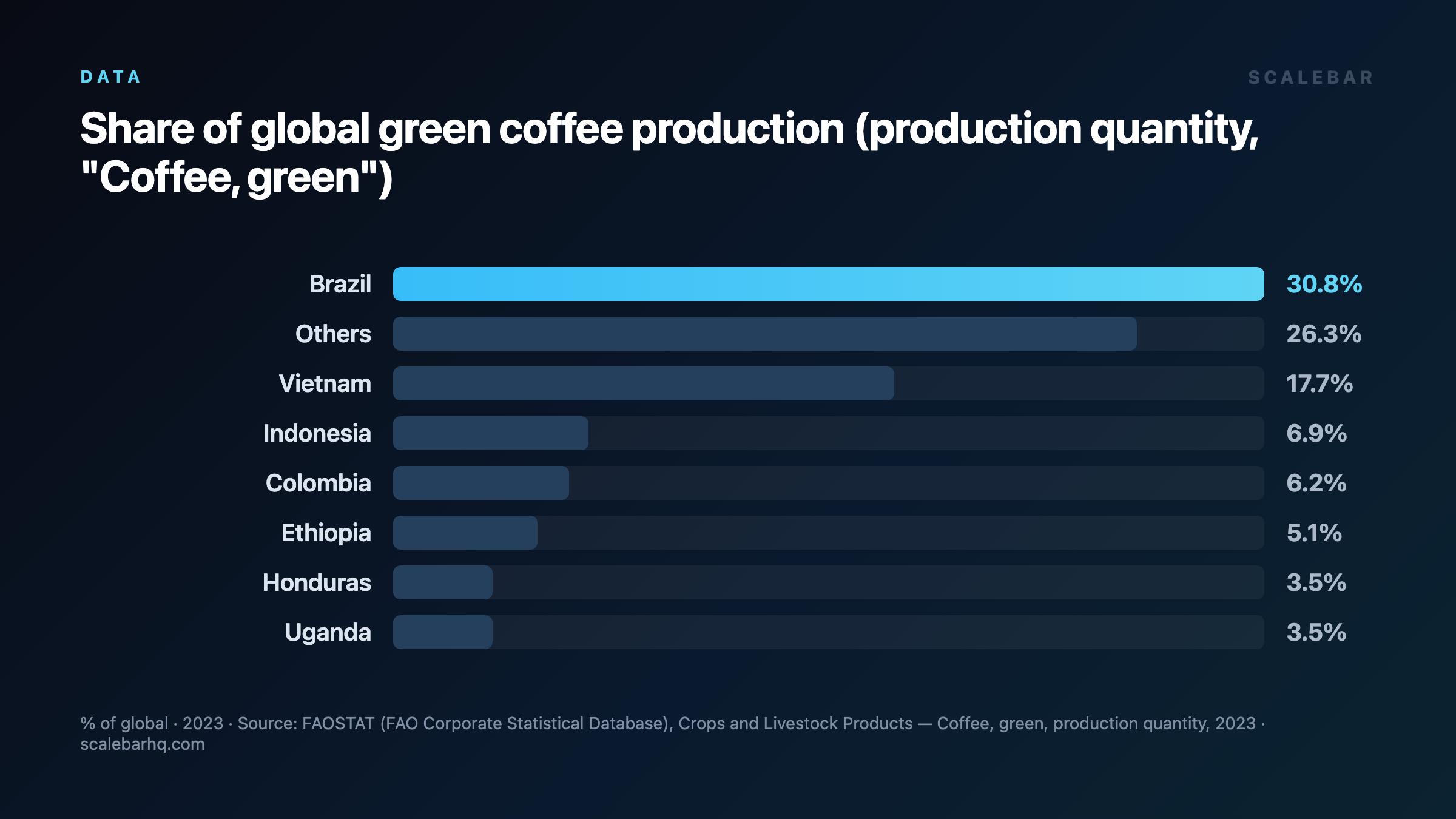
Coffee is far more than a morning ritual; it is a massive, highly integrated global commodity market. At the absolute center of this market lies a single agricultural superpower: Brazil. Producing roughly 34 to 38 percent of all the coffee on Earth, Brazil’s agricultural output shapes the daily routines of billions of people.
However, this extreme concentration of supply creates a highly sensitive global market. The thesis of modern coffee economics is simple yet stark: Brazil's dominance over the global coffee supply is so extreme that a single frost or drought in its key growing regions moves world prices overnight. When adverse weather strikes, futures prices spike within hours, and the entire world pays more for its morning cup.
---
The Scale of Brazil's Coffee Empire
To understand the sheer scale of Brazil's dominance, one must look at the physical volume of its harvest. Brazil produces approximately 66 million 60kg bags of coffee. This volume completely dwarfs the output of every other coffee-producing nation on the planet.
To put Brazil's 66 million bags into perspective, consider the outputs of its closest competitors:
- Vietnam: Produces approximately 29 million 60kg bags.
- Colombia: Produces approximately 14 million 60kg bags.
- Indonesia: Produces approximately 11 million 60kg bags.
Even when combining the entire harvests of Vietnam, Colombia, and Indonesia—the next three largest producers—their collective output still falls short of Brazil's singular contribution to the global supply.
---
Two Decades of Agricultural Expansion
Brazil's current position as an agricultural titan is the result of decades of systematic expansion and modernization. Over the last two decades, the country's coffee output has grown substantially. This growth has been heavily driven by the adoption of mechanized farming techniques, particularly across the vast, flat expanses of the Cerrado plateau.
Unlike the steep, mountainous terrains of traditional coffee-growing regions in Colombia or Central America, the flat geography of the Cerrado allowed Brazilian farmers to deploy large-scale machinery. This shift drastically increased efficiency and scaled up production volumes.
This upward trajectory is clearly visible in historical production data:
- 2005: Brazil's coffee output stood at 33 million 60kg bags.
- 2012: Production climbed to 50 million 60kg bags.
- 2018: Output reached 60 million 60kg bags.
- Present: Production sits at approximately 66 million 60kg bags.
This steady climb reflects a highly optimized agricultural sector that has successfully scaled to meet rising global demand.
---
The Dynamics of Global Coffee Trade
While Brazil dominates production, the dynamics of the export market reveal a slightly different picture. Brazil's global coffee export share sits in the range of 22 to 38 percent, with specific market assessments placing its export share at approximately 30 percent.
This export share is slightly lower than its overall production share. This discrepancy is largely explained by Brazil's own robust domestic coffee consumption; unlike many other major agricultural exporters that ship nearly their entire harvest abroad, Brazil maintains a massive internal market for its own beans.
Despite this domestic consumption, Brazil remains the undisputed leader in global exports. When combined with Vietnam, the two nations form a powerful duopoly in the international trade of coffee beans. Together, Brazil and Vietnam account for roughly two thirds of global coffee exports. Colombia, despite its high-quality reputation, accounts for a more modest 9 percent of global coffee exports, while Vietnam and Colombia fill out the next largest slices of the market alongside Indonesia.
---
The Demand Side: Rich, Caffeine-Dependent Economies
The flow of global coffee trade moves primarily from developing nations in the global South to wealthy, high-consumption economies in the North. The European Union (EU) and the United States represent the largest buyers by far.
The scale of European demand is particularly massive; the EU imports approximately 45 million 60kg bags of coffee. This high concentration of demand in rich, caffeine-dependent economies means that any disruption in the supply chain has immediate financial implications for major consumer markets.
---
The Vulnerability of Market Concentration
The extreme concentration of the global coffee supply in Brazil introduces a profound systemic risk to the global economy. In a diversified market, a localized crop failure in one region can be offset by bumper harvests in another. However, because Brazil produces over a third of the world's coffee, the global market has no buffer against a Brazilian supply shock.
This vulnerability is put on display whenever adverse weather strikes Brazilian coffee fields. The Cerrado plateau and other key growing regions are susceptible to periodic droughts and sudden frosts. Because commodity traders and financial markets closely monitor these regions, any forecast of freezing temperatures or lack of rainfall triggers immediate panic.
Within hours of a reported frost, coffee futures prices on global exchanges spike. Because coffee is traded as a global commodity, these price increases are rapidly passed down the supply chain, ultimately forcing consumers worldwide to pay more for their daily coffee. The global coffee market remains, fundamentally, at the mercy of Brazilian weather.
Frequently asked
- How much of the world's coffee does Brazil produce?
- Brazil produces roughly 34 to 38 percent of all the coffee on Earth, which equates to approximately 66 million 60kg bags.
- How does Brazil's coffee production compare to other major producers?
- Brazil's production of approximately 66 million 60kg bags dwarfs its closest competitors. Vietnam produces approximately 29 million bags, Colombia produces approximately 14 million bags, and Indonesia produces approximately 11 million bags.
- How has Brazil's coffee output grown over the last two decades?
- Brazil's coffee output has grown substantially. In 2005, Brazil produced 33 million 60kg bags. This rose to 50 million bags in 2012, 60 million bags in 2018, and currently stands at approximately 66 million bags.
- What percentage of global coffee exports does Brazil control?
- Brazil's global coffee export share is in the range of 22 to 38 percent, accounting for approximately 30 percent of the global export share. Together, Brazil and Vietnam account for roughly two thirds of global coffee exports.
- Who is the largest importer of coffee?
- The European Union and the United States are the biggest buyers by far. The EU alone imports approximately 45 million 60kg bags of coffee.
Sources
- https://www.comunicaffe.com/eurostat-in-2023-the-eu-imported-45-million-bags-of-coffee-worth-e10-6-billion
- https://www.linkedin.com/posts/commodity-trading-club_commoditytrading-coffee-agriculture-activity-7346496700561141760-7Fv0
- https://dailycoffeenews.com/2024/05/22/indonesia-coffee-report-production-and-consumption-on-the-rise
- https://dailycoffeenews.com/2025/12/15/colombia-coffee-report-production-and-prices-remain-historically-high
- https://dailycoffeenews.com/2025/06/05/vietnam-coffee-report-production-exports-and-consumption-all-rising
- https://www.solidaridadnetwork.org/wp-content/uploads/2024/06/The-Grounds-for-Sharing-annex-Vietnam.pdf
- https://www.comunicaffe.com/europes-green-coffee-imports-recovering-but-still-below-pre-pandemic-levels-shows-new-report-from-the-ecf
- https://en.wikipedia.org/wiki/Coffee_production_in_Brazil
- https://www.reuters.com/world/americas/colombia-has-best-coffee-harvest-decades-warns-lower-202526-crop-2025-10-07
- https://www.facebook.com/GlobalstatsX/posts/-top-coffee-exporters-by-country-2024-brazil-114b-222-vietnam-42b-81-switzerland/122189332382895251
- https://anthrosource.onlinelibrary.wiley.com/doi/10.1111/jlca.12293
- https://apps.fas.usda.gov/newgainapi/api/Report/DownloadReportByFileName?fileName=Coffee+Annual_Jakarta_Indonesia_ID2024-0016.pdf
- https://www.tendata.com/blogs/export/6429.html
- https://ec.europa.eu/eurostat/web/products-eurostat-news/w/edn-20241001-1
- https://www.facebook.com/RainforestAllianceAfrica/posts/did-you-know-that-brazil-has-the-largest-output-of-certified-coffee-in-the-world/863052222592092
- https://www.comunicaffe.com/usda-gain-report-brazils-production-for-2018-19-seen-at-60-2-million-bags
- https://apps.fas.usda.gov/newgainapi/api/Report/DownloadReportByFileName?fileName=Coffee+Annual_Brasilia_Brazil_BR2025-0013.pdf
- https://dailycoffeenews.com/2024/06/10/brazil-coffee-report-upward-prediction-for-production-exports-and-revenue
- https://www.gcrmag.com/brazil-production-for-2012-13-estimated-at-50-million-bags