Congo's Forests Feed the World's Furniture
The world's second-largest tropical forest quietly anchors global carbon storage and timber markets with a fraction of the Amazon's spotlight.
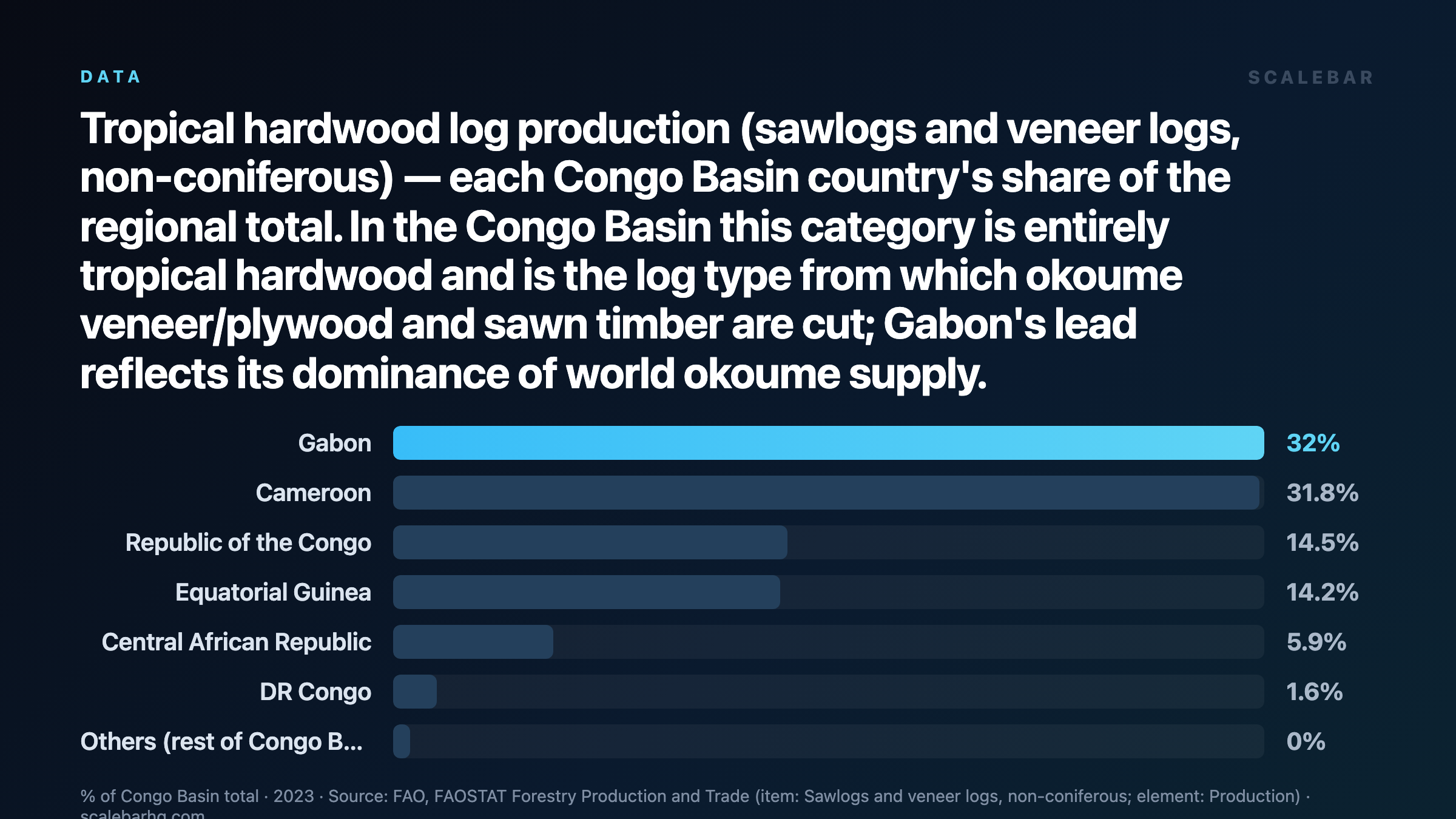
The global conversation surrounding tropical deforestation is heavily dominated by the Amazon. Yet, thousands of miles away, another massive green lung operates under a relative shroud of international silence. The Congo Basin, spanning multiple nations in Central Africa, is the world's second-largest tropical forest. Despite its immense scale and critical ecological importance, it quietly supplies global timber markets while absorbing only a fraction of the international attention and headlines dedicated to its South American counterpart.
The Scale of the Basin
To understand the global significance of the Congo Basin, one must first grasp its sheer physical footprint. The basin covers about 200 million hectares of land. This vast expanse represents roughly 18% of all tropical forest on Earth.
Within this ecological giant, the Democratic Republic of Congo (DRC) holds the largest share. Depending on the measurement methodology used by researchers and forestry experts, the DRC's portion of this tropical forest is estimated to range from 114 million to over 150 million hectares. This single nation contains one of the most concentrated and critical expanses of tropical forest on the planet, making its environmental policies and economic activities of paramount importance to global climate stability.
A Critical Carbon Vault
The ecological value of the Congo Basin extends far beyond its surface area. It serves as one of the planet's most vital carbon sinks. The carbon stored within the basin's vegetation and soils represents nearly 10% of all carbon stored in forests worldwide.
A significant portion of this carbon is locked away in the basin's unique peatlands. These peatlands alone store around 29 gigatons of carbon—a figure also quantified as approximately 30 billion tons of carbon. This massive reservoir of organic material represents a delicate climate balance; keeping this carbon safely stored in the ground is essential for global climate mitigation efforts. If these forests and peatlands are degraded or cleared, the resulting carbon release would severely complicate global climate math.
Deforestation: A Quiet Crisis
While the Amazon frequently makes front-page news for its rate of tree cover loss, the Congo Basin is experiencing its own steady, quiet crisis. Annually, the Congo Basin loses hundreds of thousands of hectares of forest. Specifically, the rate of forest loss in the region is approximately 0.63 million hectares per year.
While this loss is deeply alarming to ecologists, it remains a fraction of the deforestation seen in the Amazon. For comparison, the Amazon loses approximately 2.0 million hectares of forest per year, with losses reaching around 2.0 million hectares of forest in 2022 alone. This stark difference in scale partly explains why the Congo Basin receives far less international media coverage and environmental advocacy funding, even though its ecological health is no less vital to the biosphere.
The Global Timber Pipeline
The drivers of forest loss in the Congo Basin are deeply tied to international trade, particularly the global furniture and construction industries. The Democratic Republic of Congo's timber is a highly sought-after commodity on the international market.
The primary destination for this timber is Asia, with China playing a dominant role. China takes about two-thirds—specifically 67%—of the DRC's tropical timber exports. This timber feeds massive manufacturing hubs and furniture factories, which in turn supply consumer markets worldwide. From high-end showrooms to everyday household furniture, the wood harvested from the depths of the Congo Basin is integrated into global supply chains, often without consumers ever realizing its origin.
Livelihoods and the Informal Economy
Beyond its role as a global carbon sink and an export powerhouse, the Congo Basin is a vital economic lifeline for the people who live within and around it. The forestry sector is not merely composed of large-scale, formal export operations.
Across Central Africa, an estimated 41 million people depend on the informal timber sector for their livelihoods, food, fuel, and income. This informal sector operates alongside formal industries, providing essential economic support to millions of families in regions where formal employment opportunities may be scarce. The forest is therefore not just an ecological asset to be preserved from afar, but an active, living resource that sustains tens of millions of human lives daily.
Balancing Ecology and Economy
The Congo Basin exists at a complex intersection of global environmental necessity and international economic demand. It quietly performs the heavy lifting of global carbon sequestration, holding nearly a tenth of the world's forest carbon, while simultaneously supplying the raw materials that furnish homes across the globe. As global attention remains largely fixed on the Amazon, the future of the Congo Basin—and the millions of people and billions of tons of carbon bound up within it—will depend on how the world balances its appetite for timber with the urgent need to protect this silent giant.
Frequently asked
- How large is the Congo Basin compared to other tropical forests?
- The Congo Basin covers about 200 million hectares, making it the second largest tropical forest in the world. It represents roughly 18% of all tropical forest on Earth.
- How much carbon is stored in the Congo Basin?
- The Congo Basin stores nearly 10% of all carbon stored in forests worldwide. This includes its unique peatlands, which alone store around 29 gigatons (approximately 30 billion tons) of carbon.
- Who is the primary buyer of the Democratic Republic of Congo's tropical timber?
- China is the dominant buyer, taking about two-thirds (67%) of the Democratic Republic of Congo's tropical timber exports to supply its manufacturing and construction sectors.
- How does the deforestation rate in the Congo Basin compare to the Amazon?
- The Congo Basin loses approximately 0.63 million hectares of forest annually. While significant, this is a fraction of the deforestation in the Amazon, which loses approximately 2.0 million hectares of forest per year (including around 2.0 million hectares lost in 2022).
- How many people rely on the Congo Basin's informal timber sector?
- An estimated 41 million people across Central Africa depend on the informal timber sector for their livelihoods, food, fuel, and income.
Sources
- https://pmc.ncbi.nlm.nih.gov/articles/PMC12817162
- https://eia.org/wp-content/uploads/2024/10/Until-the-Last-Log.pdf
- https://www.globalforestwatch.org/blog/forest-insights/congo-basin-forest-loss-trends/, https://www.theinvadingsea.com/2024/04/14/tropical-forests-deforestation-greenhouse-gases-brazil-colombia-bolivia-laos-nicaragua-indonesia-drc-canada/, https://www.worldwildlife.org/places/congo-basin/, https://gfr.wri.org/latest-analysis-deforestation-trends, https://www.facebook.com/groups/BiodiversityInformatics/posts/3707704829368934/
- https://news.mongabay.com/2025/11/drc-hit-by-record-deforestation-in-2024-satellite-data-show/
- https://www.scirp.org/journal/paperinformation?paperid=108739
- https://dicf.unepgrid.ch/democratic-republic-congo/forest
- https://www.worldwildlife.org/places/congo-basin
- http://www.ambacongo-us.org/en/about-congo/congo-basin
- https://www.amazonconservation.org/maap-187-deforestation-and-fire-hotspots-in-the-amazon-2022
- https://www.facebook.com/worldwildlifefund/posts/have-you-heard-of-the-congo-basin-its-home-to-the-worlds-second-largest-tropical/1642077523950378
- https://www.academia.edu/37031137/Assessing_the_impact_of_Chinas_timber_industry_on_Congo_Basin_land_use_change
- https://gfr.wri.org/global-tree-cover-loss-data-2022
- https://joint-research-centre.ec.europa.eu/jrc-news-and-updates/amazon-region-2022-and-2023-deforestation-forest-degradation-and-risk-growing-soy-production-2024-02-28_en
- https://en.wikipedia.org/wiki/Congo_Basin, https://www.ebsco.com/research-starters/science/congo-river-basin, https://www.expeditions-ducret.com/congo-basin-forest/
- https://pmc.ncbi.nlm.nih.gov/articles/PMC12817162/
- https://www.sciencedirect.com/science/article/pii/S1389934123000308
- https://climatefocus.com/wp-content/uploads/2023/12/wwf-congo-basin-forests_executive-summary-2023_eng.pdf
- https://forestdeclaration.org/wp-content/uploads/2022/11/2022RegionalAssessment_ENG.pdf
- https://www.statista.com/statistics/270277/mining-of-rare-earths-by-country/
- https://gfr.wri.org/global-tree-cover-loss-data-2023
- https://eprints.whiterose.ac.uk/id/eprint/111018/1/Age%2C%20extent%20and%20carbon%20storage%20of%20the%20central%20Congo.pdf
- https://www.unep.org/news-and-stories/story/critical-ecosystems-congo-basin-peatlands